Chennai: Electronics manufacturing services (EMS) companies experienced a significant increase in costs during the fourth quarter of fiscal year 2026 (Q4FY26), driven by raw material cost inflation, extended working capital cycles, wage hikes, and rupee depreciation. These factors collectively squeezed profit margins across the sector.
Key Cost Drivers
The prices of memory modules surged due to global demand fueled by artificial intelligence (AI) advancements. Additionally, the ongoing conflict in West Asia increased the cost of key inputs such as copper laminates and raised logistics expenses. Higher inventory levels and the sector's heavy reliance on imported components further intensified cost pressures.
Impact on Major Players
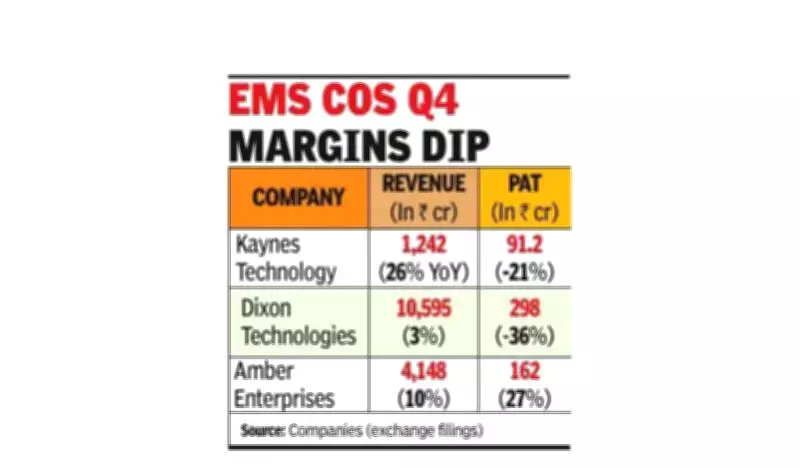
Two of the sector's largest players reported declines in profit despite strong revenue growth. Dixon Technologies, which is heavily focused on mobile devices, saw its Q4 profit after tax (PAT) fall by 36% year-on-year. This decline was attributed to softer demand, inventory rationalization by customers, memory price inflation, and geopolitical disruptions. The company's margins are expected to remain under pressure in FY27, as the mobile production-linked incentive (PLI) scheme, which contributed Rs 250 crore in FY26, has expired. Atul Lall, managing director of Dixon, stated during an earnings call that margins will be slightly under pressure but guided for a 40-50 basis point margin expansion after backward integration.

Kaynes Technology reported a 21% decline in Q4 PAT, primarily due to geopolitical risks leading to customer deferrals and a 90% drop in orders from a major electric vehicle two-wheeler customer, where it was the sole supplier. Amber Enterprises, despite posting profit growth in Q4, guided for a 50-100 basis points margin compression in FY27, citing minimum wage hikes in Haryana and Uttar Pradesh, commodity price inflation, and currency depreciation.
Exceptions to the Trend
Syrma SGS bucked the trend with Q4 PAT growing by 67%, driven by its diversified business-to-business (B2B) segment mix and an increase in its original design manufacturing (ODM) business from 12% to 17% of revenue. Avalon Technologies also performed well, with Q4 PAT growing by 69.5%, aided by its US subsidiary.
Analyst Perspectives
Analysts expect the pressure to persist in the first half of FY27, with a recovery likely in the second half. Kranthi Bathini, equity strategist at WealthMills Securities, said margins are expected to contract in the short to medium term due to inflation, geopolitical tensions, and supply chain concerns. "The increase in cost of key raw materials and higher inventory and logistics costs are headwinds, but it is too early to gauge the full impact. Companies are expected to improve margins in the next couple of quarters," he added.
Chirag Jain, deputy head of research at Emkay Global Financial Services, noted that some companies have been conservative with guidance, which has driven these concerns. He added that continued demand, global supply chain diversification to India, and policy support offer significant growth opportunities. "EMS companies still have levers to improve margins with better segmental mix, operating performance, and increasing backward integration," he said.
Chanpreet Singh, founder of investment advisory firm AltQube, highlighted that the EMS sector's pain was sharper than the broader market, with Nifty50 Q4 PAT growth at 8-9%. "EMS aggregate profits declined despite 30%-plus revenue growth. This is a growth-tax quarter with scale without earnings translation," he concluded.