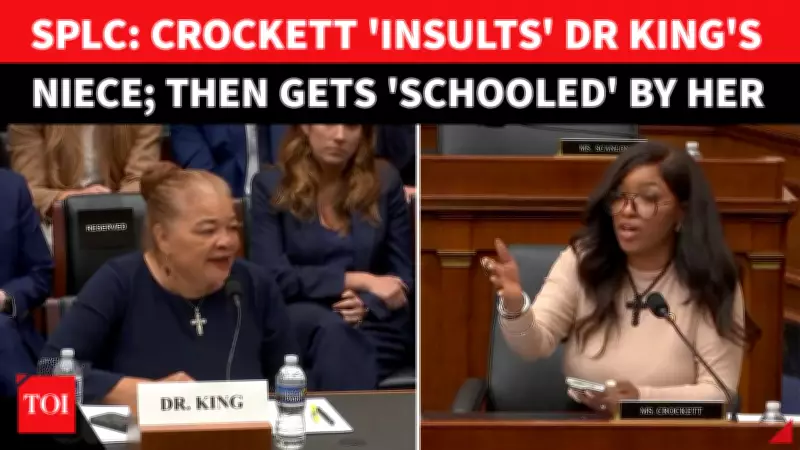
A congressional hearing involving the Southern Poverty Law Center (SPLC) took an unexpected turn after Representative Jasmine Crockett made remarks about 'white men parading Dr. King,' which sparked sharp criticism online. The controversy intensified after Bernice King, the daughter of civil rights icon Martin Luther King Jr., publicly responded to the debate surrounding her father's legacy.
Background of the Incident
The hearing, which focused on the SPLC's activities and funding, became heated when Crockett, a Democrat from Texas, criticized what she described as the selective invocation of Dr. King's message by certain political figures. She specifically targeted 'white men' who she claimed were using Dr. King's name to advance their own agendas without honoring his true legacy.
Her comments were met with immediate backlash from conservative commentators and politicians, who accused her of divisive rhetoric and of mischaracterizing those who admire Dr. King. Social media platforms erupted with debates, with many users questioning the appropriateness of Crockett's remarks in a formal hearing setting.

Bernice King's Response
Bernice King, a prominent activist and minister, took to social media to address the controversy. In a series of posts, she emphasized the importance of focusing on Dr. King's core teachings of justice, equality, and nonviolence rather than engaging in partisan bickering. She stated, 'My father's legacy belongs to all who seek justice, not to any one group or political party.' While she did not directly name Crockett, her comments were widely interpreted as a call for unity and a rebuke of attempts to weaponize her father's words.
Broader Implications
The exchange has reignited broader discussions about who gets to invoke Dr. King's message in contemporary political battles and whether his words are being selectively interpreted to advance partisan narratives. Many civil rights leaders and historians have weighed in, noting that Dr. King's legacy has often been co-opted by various factions to support conflicting agendas.
Some supporters of Crockett argued that her comments highlighted a genuine concern about the appropriation of Dr. King's legacy by those who oppose the very policies he championed, such as voting rights and economic justice. Critics, however, maintained that her remarks were unnecessarily inflammatory and detracted from the substantive issues at hand.
Reactions from Political Figures
Several Republican lawmakers condemned Crockett's remarks, with one calling them 'disgraceful' and 'divisive.' Meanwhile, some Democratic colleagues defended her right to raise concerns about how Dr. King's legacy is used in political discourse. The SPLC itself issued a statement reaffirming its commitment to honoring Dr. King's work but did not directly address Crockett's comments.
Conclusion
The incident underscores the deep polarization surrounding the interpretation of historical figures in modern politics. As the debate continues, it remains to be seen whether this controversy will lead to more nuanced conversations about Dr. King's legacy or further entrench existing divisions.