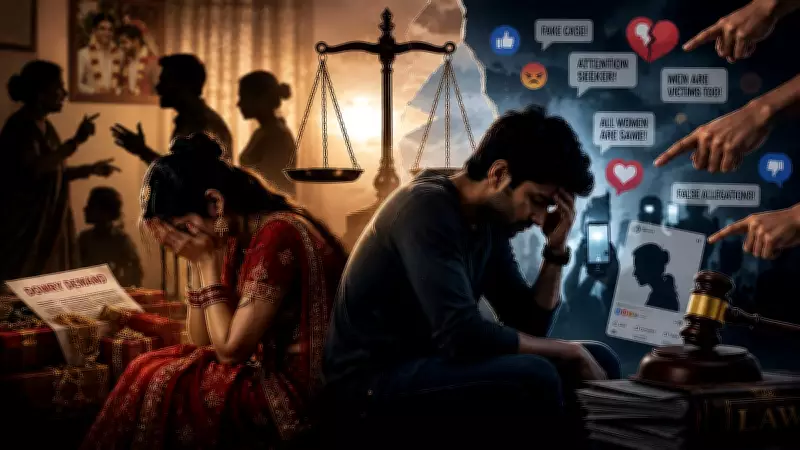
India reports over 15 dowry deaths daily, yet social media conversations often divert the narrative to men's rights, according to psychologists and legal experts. Recent cases like Twisha Sharma and Atul Subhash have become online battlegrounds, where discussions on domestic violence are overshadowed by 'whataboutism'.
The Reality of Dowry Deaths in India
Official data reveals that more than 15 women die every day due to dowry-related violence. Despite stringent laws like the Dowry Prohibition Act, 1961, and Section 304B of the Indian Penal Code, convictions remain low. Experts attribute this to societal norms, underreporting, and judicial delays.
Social Media's Role in Shifting the Debate
High-profile cases often trigger polarized debates online. In the case of Twisha Sharma, a young woman who died under suspicious circumstances, many social media users questioned the motives of her family rather than addressing dowry harassment. Similarly, Atul Subhash's case saw a surge in posts claiming false accusations by women. Psychologists note that this 'whataboutism' minimizes the severity of domestic violence.

Dr. Ananya Mehta, clinical psychologist, explains: 'When a tragedy occurs, social media often amplifies the most controversial angle. This distracts from the systemic issue of dowry deaths and creates a false equivalence between victims and perpetrators.'
Legal Experts Weigh In
Advocate Rohan Desai points out that while men's rights groups raise valid concerns about misuse of laws like Section 498A, it does not negate the reality of dowry deaths. 'The statistics are clear: thousands of women die annually due to dowry demands. We need balanced reforms, not a complete dismissal of women's safety,' he says.
The 'Whataboutism' Phenomenon
'Whataboutism' refers to deflecting criticism by raising a different issue. In the context of domestic violence, it often manifests as 'what about men who are falsely accused?' Experts argue that this tactic undermines efforts to address violence against women.
- Data distortion: Selective use of statistics to argue that men are equally victimized.
- Emotional manipulation: Sharing anecdotes of false cases to evoke sympathy for men.
- Polarization: Creating an 'us vs. them' narrative that prevents constructive dialogue.
Impact on Policy and Public Perception
This online shift affects real-world policies. Some politicians and influencers call for repealing dowry laws, citing misuse. However, women's rights activists warn that such moves could embolden perpetrators. 'The focus should be on better implementation and support for victims, not on dismantling protections,' says Sunita Rao, founder of a women's helpline.
Call for Balanced Conversations
Psychologists urge social media users to critically evaluate content. 'Ask yourself: does this post help solve the problem or just create outrage? Recognize when a discussion is being hijacked,' advises Dr. Mehta.
Legal experts recommend strengthening enforcement mechanisms and providing more resources for both men and women facing genuine issues. 'We need a nuanced approach that acknowledges the suffering of all victims without erasing the scale of dowry deaths,' concludes Advocate Desai.