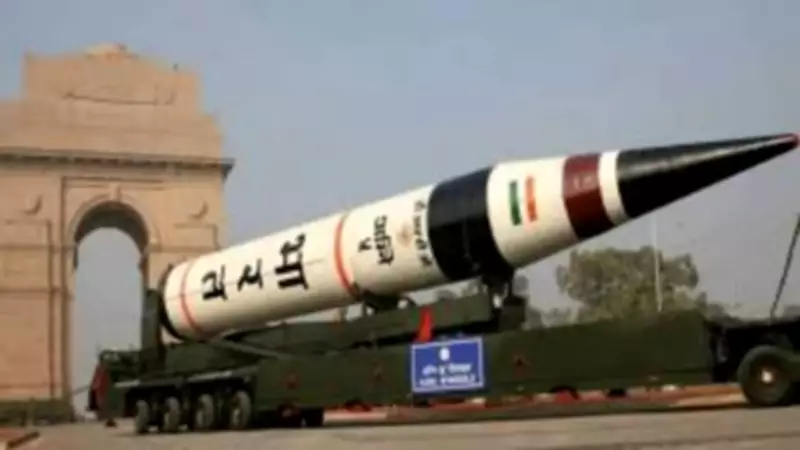
In a drastic shift in its nuclear weapons policy, India has for the first time 'deployed' 12 nuclear warheads, according to the latest report from the Stockholm International Peace Research Institute (SIPRI), the world's top arms-tracking organisation. The report also states that India's total nuclear warheads have increased to 190 as of January 2026, up from 180 a year earlier.
Operational Deployment Marks Policy Departure
The SIPRI report claims this is the first time India's nuclear arsenal has been classified as operationally deployed rather than stockpiled — a significant departure from New Delhi's decades-long policy of keeping nuclear warheads and delivery systems in separate storage during peacetime. 'It has long been assumed that India stores its nuclear warheads separate from its deployed launchers during peacetime. However, the country's recent moves towards placing missiles in canisters and conducting sea-based deterrence patrols suggest that India could be shifting in the direction of mating some of its warheads with their launchers in peacetime,' the report said.
Deploying ready-to-fire nuclear weapons in underground missile silos and new nuclear submarines indicates heightened readiness of the Indian armed forces. The 12 newly deployed warheads represent the first instance of India mating nuclear warheads with delivery systems or placing them at bases with operational forces.

Nuclear Triad Maturation
The SIPRI report further notes that India's nuclear weapons stockpile witnessed a marginal increase over the past year. 'India was estimated to have a growing stockpile of about 190 nuclear weapons as of Jan 2026 — a small increase from the previous year. These weapons were assigned to a maturing nuclear triad of aircraft, land-based missiles and SSBNs,' the report said. India continues to modernise its nuclear capabilities and develop new long-range delivery systems.
Comparison with Pakistan
Pakistan's stockpile remains unchanged at approximately 170 warheads. SIPRI noted that Pakistan continued to develop new delivery systems and accumulate fissile material in 2025, suggesting its nuclear arsenal might expand over the coming decade. The report also referenced the brief armed conflict between India and Pakistan in May 2025, where India attacked Pakistani air and missile bases likely to have nuclear-related roles, but both sides took steps to avoid escalation.
No First Use Policy
India maintains a 'no first use' policy regarding nuclear weapons. The country's limited but effective nuclear arsenal is designed purely to deter potential aggressors rather than engage in an arms race.
Global Nuclear Scenario
At the start of 2026, nine states — the US, Russia, the UK, France, China, India, Pakistan, North Korea and Israel — together possessed approximately 12,187 nuclear weapons, of which 9,745 were in military stockpiles and considered potentially operationally available. Overall, the number of nuclear warheads worldwide continues to decline, but this is only due to the US and Russia dismantling retired warheads.
Military Spending
The US remained the largest military spender globally at $954 billion in 2025, accounting for 33% of total global spending. China was second at $336 billion, Russia third at $190 billion, Germany fourth, and India fifth with $92.1 billion — an increase of 8.9% over the previous year. The 15 largest military spenders together accounted for 80% of world military expenditure in 2025.