In April 2026, a robotics company did not send a university a brochure. They sent their engineers. The builders of industrial-grade robotics and humanoid systems moved a working team onto campus for three months, not for a workshop, not for a recruitment drive, but to build. Their engineers set up a fully operational robotics centre, running live programmes in applied robotics and faculty development alongside students, on real projects.
That distinction matters. Most industry-academia partnerships exist as logos on a letterhead. This one showed up with equipment. That university is Shoolini. Shoolini University in Himachal Pradesh ranks among India's most research-active private universities. Over the last decade, it has built something harder to replicate than a curriculum, an environment where industry does not just endorse education, it participates in it.
"Organisations the world over are looking to fill skill gaps in AI, automation and robotics. This centre reiterates Shoolini's focus on innovation embedded into our pedagogical design - enabling students to become creators and problem-solvers before they enter the workforce," said Vishal Anand, Founder and Pro Chancellor, Shoolini University.

Not a Subject on a Timetable, But a Way of Working
The right question to ask of any engineering programme is not 'Do they teach AI?' Every university says yes now. The better question is: what does a student actually do with AI, across every year and does the infrastructure demand real capability, not just familiarity?
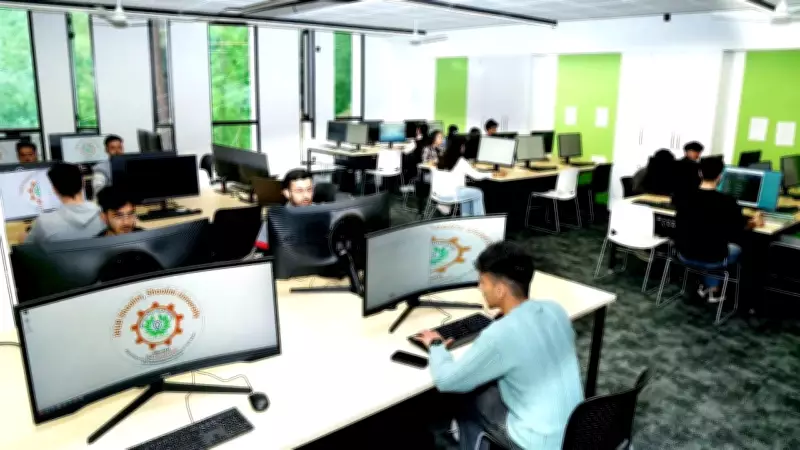
At Shoolini, the B Tech CSE programme runs on cloud infrastructure powered by AWS, Microsoft Azure, IITs, and Algo8. Students don't just study the theory but build Large Language Models, and deploy Agentic AI systems. Startups are launched and funded here, on campus, before graduation.
Highlighting this, Prof. Ashish Khosla, President, Shoolini University & Director, Yogananda School of AI, said, "By working together in transformative areas such as AI, Large Language Models, and Blockchain, we aim to provide our students and faculty with direct exposure to the cutting edge of technology. Partnerships like these ensure that our learners are prepared not only for today's careers, but for the technologies that will define the future."
From Student Research to Hospital Software: AI Meets Medicine
One of Shoolini's most differentiating stories is not in computer science. It's in a lab. A research team led by Associate Professor Gaurav Gupta built an AI model to detect breast cancer earlier and more accurately than current standard approaches. All this is designed for integration with hospital software and diagnostic apps, with rural India specifically in focus. This is published research with a direct application in the healthcare system.
In the School of Pharmaceutical Sciences, students are running Python-based analyses on real drug datasets, training in AI-driven compound generation and retrosynthesis. At Pharma Anveshan 2026, backed by BIRAC and the Department of Biotechnology, the focus moved further upstream: how AI analyses genomic data to identify disease-causing genes and compress discovery timelines that once took years.
This is AI fluency that crosses disciplines. It is also what makes a pharmacy or biotech graduate genuinely distinctive in 2026.
The Infrastructure That Makes All of This Possible
This is what it means to have AI embedded in the infrastructure, not just the syllabus. This level of work requires infrastructure that most universities don't have at undergraduate level. The Bio-Innovation Centre - funded through a Rs 9-crore DST-PURSE grant, the first of its kind in Himachal Pradesh - puts confocal microscopes and cell-sorting systems in the hands of first-year students under the Summit Research Program. Nineteen Shoolini scientists appear on Stanford University's list of the world's top 2% of researchers. These are the people supervising the students' first-year projects.

What does this mean for a student, practically? By the time a Shoolini student graduates, they would have worked on live research, collaborated with industry engineers operating on campus, earned a formal AI certification co-issued with IIT Ropar, and - if they qualify - received scholarship support from a pool of Rs 5 crore available to incoming students. The employers hiring four years from now are not going to ask how many AI courses were on the syllabus. They're going to ask what a candidate built, who they built it with, and whether they can do it again. At Shoolini, that answer starts in semester one.
To know more about Shoolini, visit their website.
Disclaimer: This article has been produced on behalf of Shoolini University by Times Internet's Spotlight team.