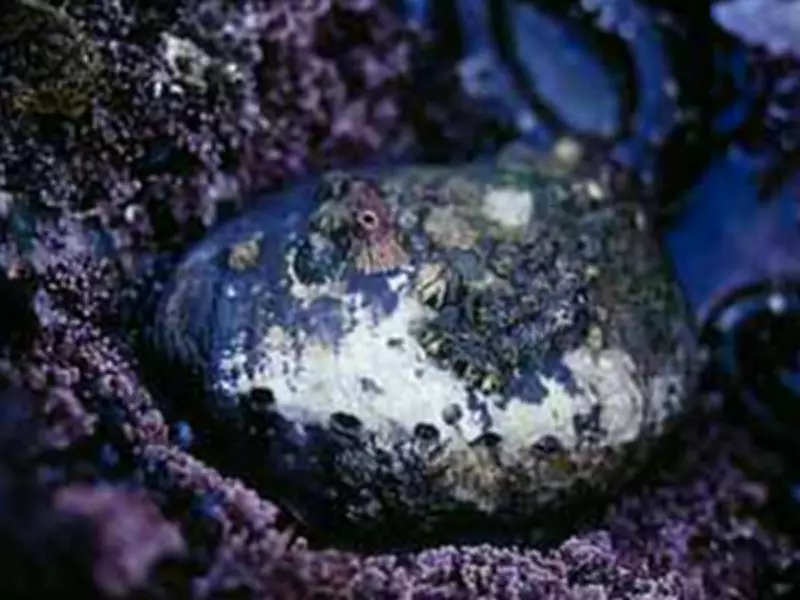
The rocky California coast was once home to dense communities of black abalone. For Native American tribes, these large marine snails were a plentiful food source, and for the commercial fishing industry, the molluscs supported a profitable fishery. In fact, these snails were once widespread along much of the Pacific coast of North America.
Then came a devastating collapse. In the mid-1980s, a deadly pathogen known as withering syndrome killed an estimated 99 percent of black abalone across a wide stretch of its geographic range. The collapse was so catastrophic that in 1993, black abalone fishing was banned, and the animal was later listed as endangered.
Now, nearly four decades after the biological catastrophe, scientists have discovered a surprising clue as to how this species survived. By sequencing ancient DNA preserved in shells up to 1,500 years old, the research team determined that modern black abalone populations retain significantly more genetic diversity than was previously suspected. The findings were published in the journal Proceedings of the National Academy of Sciences (PNAS) and could reshape conservation efforts to save one of California's most threatened marine species.

An Ancient Shell Provides a Time Machine for DNA
Researchers at the University of California, Santa Cruz, sequenced genomes from 59 samples of black abalone shells that were gathered from museum collections, archaeological sites, and contemporary populations. One of the oldest specimens was a shell found in an Indigenous shell midden dating back approximately 1,500 years. A shell midden is an archaeological deposit created when people discard shells, providing clues about past ecosystems.
Researchers modified a technique used to sequence DNA from fossil bones to extract preserved genetic material from the shells. Using specialised sterile labs, the scientists pulverised the small shell pieces and then processed them in order to retrieve small quantities of DNA that had withstood the centuries of decay. Lead author Brock Wooldridge described shells as a largely untapped scientific resource, noting that museum collections and archaeological sites contain vast numbers of specimens capable of revealing ecological histories that would otherwise remain hidden.
Scientists Expected Genetic Damage, but Found the Opposite
The researchers had expected the results to be disheartening. When populations experience crashes of this magnitude, genetic diversity often declines. The reduced diversity of a species typically makes it harder for it to adapt, which can make recovering the population after a significant bottleneck challenging and slow. However, when scientists compared the genomes found in ancient shells with DNA from living black abalone, an unexpected discovery was made. According to the study, genetic diversity, levels of inbreeding, and population structure in modern and historical populations were remarkably similar across these metrics both before and after the outbreak.
In essence, even after nearly wiping out the entire population, the survivors appear to have retained much of the genetic variation present before the collapse. The researchers suggest that relatively little evolutionary time has passed since the bottleneck. Since the last major die-off of black abalone occurred only about ten generations ago, the species has not had enough time to experience serious erosion in genetic diversity. Computer simulations done for the study also confirmed that there is a time lag before the full impact of a population crash can be felt genetically.
Emerging Evidence of Adaptation to Disease Might Exist
Another surprising development in the study revealed that immune-related genes showed signs of recent natural selection in the past generation, offering yet another ray of hope. This suggests that some black abalone survivors are potentially associated with disease resistance to the disease that almost drove the species to extinction. This implies that survivors are not just surviving by chance alone but perhaps as a result of natural selection, favouring individuals that exhibit heightened resilience, according to the scientists. The finding offers fresh hope for conservationists who have spent decades trying to protect remaining populations along the coasts of California and Mexico.

Significance for Conservation Efforts
The discovery comes at a crucial time for black abalone conservation efforts. Wildlife officials in California frequently utilise translocation efforts to help restore struggling species and populations; transferring individuals from one place to another helps to ensure genetic diversity is not lost. The findings suggest that concerns about severe genetic deterioration may be lower than expected. The researchers did identify one important exception. Around Point Conception, a biologically important coastal region near Santa Barbara, they discovered genetic differences associated with chromosomal inversions that appear to vary on either side of the headland. As a result, the study recommends avoiding the transfer of abalone across this particular boundary.
One Lucky Find
Typically, wildlife conservation stories emphasise what is lost, but this finding is one about resilience. Black abalone experienced one of the most severe marine population declines recorded along the U.S. West Coast, yet they seem to have retained their evolutionary genetic makeup and perhaps even show signs of future adaptation against the disease that caused the decline. Although genetic erosion could still occur if these species are not able to multiply quickly enough, scientists are hopeful that there is a window to rebuild populations before genetic erosion potentially becomes an irreversible process.