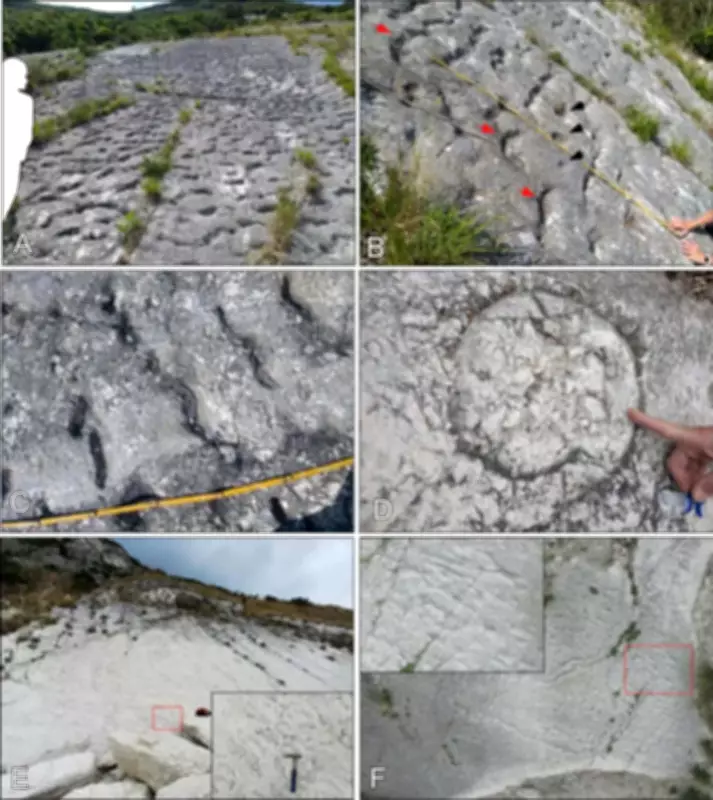
Rock climbers in the Umbria-Marche Apennines of central Italy have stumbled upon a remarkable prehistoric discovery: a fossilized underwater stampede of ancient sea turtles. What began as a typical Sunday climb along a high cliff overlooking the Adriatic Sea turned into an extraordinary find when climbers noticed unusually deep and parallel grooves cut into the rock face.
From Climbing Route to Geological Treasure
The climbers, recognizing the structured nature of the marks, ruled out recent erosion and contacted local geological authorities. Geologists climbed the cliffs to inspect the grooves, using drone imaging and rock samples to reconstruct the ancient event. Their findings were published in the journal Cretaceous Research.
The Geological Context
Millions of years ago, the area now forming the Apennine mountains was a deep seabed. Over time, geological forces lifted it to its current height. The grooves were found within the Scaglia Rossa Formation, a pink limestone layer dating to the Late Cretaceous epoch, about 80 million years ago.

An Ancient Earthquake and a Desperate Escape
According to the study, a powerful earthquake shook the ocean floor near the end of the Late Cretaceous. The tremors panicked a group of sea turtles, which frantically used their strong front limbs to push off the seabed and slide away, creating a chaotic network of grooves.
Preserved in Stone
Under normal ocean conditions, such tracks would disappear within hours or days due to waves and burrowing organisms. However, the earthquake triggered an immediate mudslide that buried the prints under thick sediment. Over millions of years, the sediments fossilized under pressure, preserving the tracks as a time capsule.
This discovery highlights the perfect geological conditions needed to preserve such delicate traces. A separate study in Terra Nova on earthquake-induced turbidites explains how tectonic shocks in the region routinely caused underwater slope failures, which in this case sealed the turtle footprints.
The TOI Science Desk, a team of journalists dedicated to covering scientific discoveries, reported on this fascinating find, emphasizing the role of serendipity and collaboration between climbers and scientists in uncovering Earth's ancient history.