Sixteen women die every day because of dowry. Not in some distant, sepia-tinted decade of bride-burning headlines and cautionary social dramas – but in 2024. Recent cases such as those of Deepika Nagar and Twisha Sharma are reminders that dowry is not a relic of another India. And yet, ask a Gen Z Hindi film viewer if they remember watching a film that talks about dowry, and the answer is likely to be, “Not really. That was an 80s thing, right?”
They might, however, remember laughing at it. In 3 Idiots (2009), Raju Rastogi’s mother worries about how she will get her daughter married if Raju does not earn well because the groom’s family wants a car. It lands like a throwaway gag. The audience laughs. The scene moves on. But, nobody calls it dowry.
Hindi Cinema and TV Have Not Stopped Telling Dowry Stories
But both have simply stopped calling it that. The old villainous saas, the humiliated bride’s father and the direct demand for cash may have faded from mainstream frames. Dowry now survives in softer, more respectable words. Think ‘gifts’, ‘expectations’, ‘status’, ‘safeguarding the couple’s future’ and ‘shaadi achhi honi chahiye’.

The Era When Films Said Dahej Out Loud
Films like Jawala Dahej Ki, Dahej, Yeh Aag Kab Bhujegi and Ek Din Bahu Ka dealt with the issue of dowry in Indian society. There was a time when Hindi cinema did not look for euphemisms. Early social dramas said ‘dahej’ plainly, sometimes even putting the word in the title. V Shantaram’s Dahej (1950) named the monster directly. Shantaram, who believed in entertaining the audience while delivering a message, told the story of a beloved daughter destroyed by her in-laws’ greed, while her father arrived too late with the wealth they demanded. The film also established Lalita Pawar as the quintessential wicked mother-in-law for a generation of audiences.
For the next few decades, Hindi cinema kept returning to the subject with new anxieties. By the 1980s, the focus had shifted from aristocratic tragedy to middle-class joint families. T Rama Rao’s Sansar (1987) stripped the Indian wedding of its sacred pretensions entirely. When Raj Babbar’s character demands the Rs 18,000 he spent on his sister’s wedding before leaving the family home, the film transformed marriage expenses into a weaponised financial ledger. No villains, no burning kitchens. Just resentment.
“There would be films made on dahej. There would be films made on women’s empowerment,” recalls Scam 1992, Rana Naidu screenwriter Vaibhav Vishal. “They would be loud, they would be larger than life, but they would also be talking about these issues. They did a phenomenal job of that.”
The Vengeful, Vigilante Bride
The 1990s gave us the vengeful bride. In Ghar Ho To Aisa (1990), Meenakshi Seshadri’s character enters a toxic household to take on an abusive mother-in-law. In Mehndi (1998), a young Rani Mukerji replaces wedding vows with vows of destruction. Films like Sau Din Saas Ke (1980) and Lajja (2001) also relied on loud villains and heightened suffering, but they understood one thing clearly: dowry was not just about money changing hands. It was about a woman’s worth being assessed before she even entered her marital home.
“We cannot disagree with the fact that dowry is very much there in India. It’s in the layers. Some call it a gift, or ‘sankalp’. It has different names. I would call it extortion,” said Akshay Kumar during Raksha Bandhan promotion.
TV Saw What Films Softened
Television kept it considerably more real. Agle Janam Mohe Bitiya Hi Kijo (2009) showed what happens in the absence of dowry in rural India: women become tradable assets, their lives a transaction between poverty and a wealthy landlord’s household. Service Wali Bahu (2015) identified something newer – the working woman’s monthly salary reframed as a modern, ongoing dowry, extracted from an educated bride under the guise of family contribution.

In 2024, producer JD Majethia dealt with the subject in Kuch Reet Jagat Ki Aisi Hai. “This tradition of dowry continues under cover even today, and it is not just in small towns and cities, but in big ones too. I felt I needed to start something like this (Kuch Reet Jagat Ki Aisi Hai) to impact lives,” he said while launching the show. Then there was the subtler, perhaps more insidious version that writer Gajra Kottary wove into Balika Vadhu (2008) – what she calls a “reverse of dowry.” “It’s like ki gareeb ghar ki ladki le aao, hamein paise ki kami nahi hai,” she recalls, “But then we can dominate her because she is going to be so grateful for coming into a rich household.”
Modern Dowry Story Has Travelled into Satire, Black Comedy
Research has complicated the idea that education kills dowry. Economist Soumyanetra Munshi’s paper, Education and Dowry: An Economic Exploration, argues that sometimes dowry rises with the groom’s level of education and is largely unrelated to the bride’s education. In simple terms, the degree itself becomes economic value. The groom’s qualification becomes a rate card.
Modern storytelling has understood this shift. In Made in Heaven (2019), a seemingly progressive IAS officer stands silent while his parents hold up the baraat at the gates, demanding Rs 4 crore in cash. When his bride confronted him, his response was, “The money is for us only. How does it matter?” In Kathal (2023), a police constable’s stolen Nano is not just a comic subplot; it is the car he bought to meet a dowry demand for his daughter’s marriage.
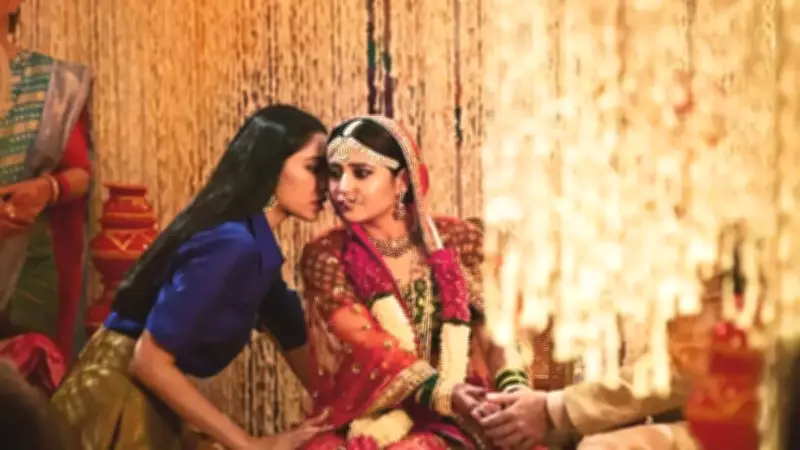
This scene from Made In Heaven’s Price of Love episode left a lasting impression on viewers. The bride finds out about her ‘simple’, ‘down-to-earth’ IAS husband’s dowry demand in the middle of the wedding ceremony. She confronts him and then, in a powerful scene, walks out of the venue after adding, “I’ll not pay anyone to marry me.”
Yashowardhan Mishra, who directed Kathal, says the film wanted to explore how social identities shape even those who enforce the law. “The law enforcers are both victims as well as perpetrators of a crime,” he says. For him, satire offered a way to enter a difficult subject without turning it into a lecture. “Satire is a great way to communicate complex issues to a mass audience and invoke critical thinking,” he shares. That is where the modern dowry story has travelled: into satire, OTT drama, thrillers and black comedy. In Dahaad (2023), women become vulnerable precisely because marriage without dowry feels impossible.
In the climax scene of Laapataa Ladies (2024), as Jaya’s husband comes to claim her – and her jewellery – she exclaims that the jewellery is hers, to which her husband responds with nonchalance, “Dahej dulhe ka hota hai.” Early in the film, his mother is heard boasting to other grooms in the train that they got a motorcycle, Rs 1.5 lakh cash and a mobile phone.
Channels Thought Dowry Was Too Gloomy
So, did dowry disappear from Hindi entertainment storytelling? Not exactly. “Unfortunately, what has happened in the last 20-25 years is that we’ve stopped making movies like that,” says filmwriter Vaibhav Vishal. His point is not just about dowry, but about the slow disappearance of a certain kind of mainstream social cinema: films that once placed dahej, poverty, women’s empowerment and communal harmony inside loud, accessible narratives.
Kottary pitched dowry-centric shows to channels but was turned away, after being told that dowry “doesn’t happen now” or that the topic is “too gloomy.” The industry, she says, increasingly treats social responsibility as an inconvenience. “A writer’s job is to entertain. Please don’t come with any baggage of social responsibility.” Even dowry, she notes, has been pushed into what people in channels dismiss as jhandagiri: sloganeering, flag-waving, a subject that makes rooms uncomfortable and sponsorship uncertain.