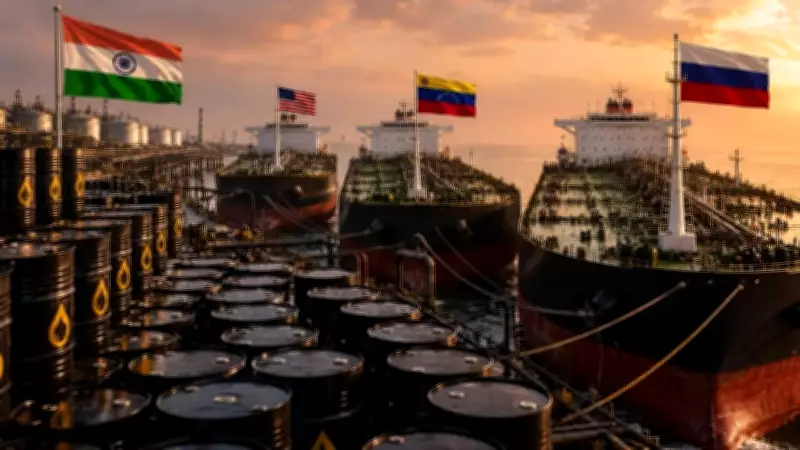
US President Donald Trump announced in February that India would stop buying Russian crude oil and step up energy ties with the United States. Four months later, India's Russian oil imports are near record highs, and the US still does not rank among India's top five crude suppliers. However, India has increased its LPG and LNG imports, and Venezuela has become an important crude supplier, substituting constrained supplies from the Middle East.
Venezuela's acting President Delcy Rodríguez recently visited India to focus on expanding energy ties. US Secretary of State Marco Rubio was also in India in late May, emphasizing energy cooperation in a meeting with Prime Minister Narendra Modi.
How India Has Managed the Strait of Hormuz Oil Crisis
Geopolitical developments in recent months have shaped India's energy supplies. The US-Iran conflict disrupted shipments via the Strait of Hormuz, forcing India to rely on alternative sources. Experts believe Russian crude will remain a major contributor to India's energy imports, but there is significant scope for expanding India-US energy ties through LPG and LNG.

Top Crude Oil Suppliers for India Amid the US-Iran Conflict
In the three months since the conflict began, Russia has remained the dominant supplier of crude oil to India. US crude imports have declined, while Venezuela has emerged as a key supplier, ranking among the top five. According to Kpler, a global data analytics provider, Russia was India's largest crude supplier in May, with imports nearing 2 million barrels per day, levels last seen in 2023.
Notably, the UAE ranked second in May with an average of 561,000 barrels per day, while Saudi Arabia dropped to third place with 350,000 barrels per day. Despite US sanctions imposed in late November, Russia continued to be the biggest contributor, though volumes fell initially. The US-Iran conflict then prompted India to source crude from all available channels as Middle East supplies via the Strait of Hormuz were disrupted.
India has consistently stated that its crude procurement decisions are driven by energy security needs. The US sanctions waiver for Russian crude has made the oil financially viable. Experts note that Russian crude itself is not sanctioned; only specific companies like Lukoil and Rosneft are. Non-sanctioned Russian crude continues to flow to India, and this trend is likely to persist even after the waiver lapses.
Can the US Replace Russian Oil in India's Crude Imports?
Experts argue that India's crude purchasing strategy is primarily economics-driven, making it unlikely that US crude will surpass Russian imports. Ivan Mathews, Head of APAC Analysis at Vortexa, states, "Unless the US and India have a formal trade deal, India is unlikely to purchase more US crude due to high freight costs from the US Gulf Coast." Additionally, US crude is mainly light/medium sweet, while Indian refineries are configured for medium/heavy sour grades. "Russian Urals is a close quality replacement for Middle Eastern crude and is more economical than US crude," Mathews adds.
Prashant Vasisht, Senior Vice President at ICRA Ltd, notes that freight costs make US crude more expensive than supplies from closer regions like West Asia.
Venezuela Crude Emerges as a Factor
Venezuelan crude is well-suited to India's refining system. Mathews says, "We could see more imports of Venezuelan crude if pricing is favorable and Strait of Hormuz transits remain constrained." Vasisht adds, "Venezuelan crude is heavy and sour, making it cheaper and economically attractive for refineries." However, combined US and Venezuelan supplies are still far below Russian volumes.
Not Crude, But LPG and LNG in Focus
While crude oil dominates headlines, LPG and LNG supplies may form a more natural fit for India-US ties. India, which sources much of its LPG and LNG from the Middle East, has shifted to US imports during the West Asia crisis. Experts believe the future of India-US energy trade lies in gas, not crude oil.

Sumit Ritolia of Kpler says, "The strongest growth in bilateral energy trade is likely to come from LNG, LPG, and ethane." Recent trends show steady growth in these imports, driven by rising domestic demand, expanding petrochemical capacity, and diversification efforts. Ivan Mathews notes that India could purchase more US LPG to replace lost supplies from the Middle East, as few alternative suppliers exist.
Vasisht highlights that LPG procurement from the US makes sense for diversification. "LNG exports from the US are usually pegged to Henry Hub, which has been cheaper than Brent-linked LNG imports, making them economically viable." Ritolia adds, "For India, US gas is becoming increasingly important for energy security, trade deals, industrial growth, and the energy transition."
Future of Russia and US in India's Energy Mix
Strait of Hormuz disruptions, tighter Middle Eastern flows, and geopolitical fragmentation are forcing India to rethink supply security and reduce overdependence on any single region. India has diversified its crude procurement to over 40 countries. Since Russian crude itself is not sanctioned, it is likely to remain an important part of India's import basket, albeit with reduced volumes after the waiver ends.
However, as Ritolia notes, there are natural limits to US crude integration due to India's refining configuration. "While Russian and Middle Eastern crude will remain central, the US sees an opportunity in LNG and LPG. India's gas demand is expected to rise rapidly with economic expansion, industrial growth, and cleaner-fuel policies," he concludes.