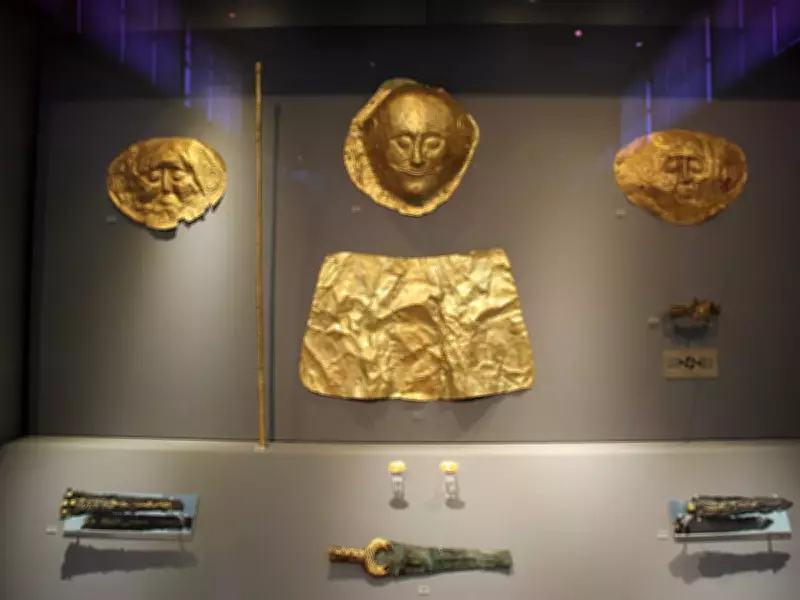
In 1876, Heinrich Schliemann's excavations inside the citadel at Mycenae revealed shaft graves full of gold. The discovery was shocking for its wealth and because it provided physical evidence for a Bronze Age world previously known mainly from myth. Early Greece had often been treated as a literary or mythic past rather than a historical culture. The digs helped shift views of the legendary past toward archaeological plausibility.
A hill opening onto another time
When the digging team at Mycenae broke ground, they did not just find old bones. They revealed a total burial landscape, one that connected architecture, repeated use, and visible markers of memory. According to teaching resources from Dartmouth College, Grave Circle A was part of a broader Mycenaean cemetery pattern wherein tomb organization and stone monuments, called stelai, were employed as symbols of social status. That suggests the graves were meant to be seen, remembered, and read by the public. The shaft graves contained rich objects placed with the dead. They provided a social arena in which elite families made claims about their identity and power through the form of the burial itself and the precious objects placed within. Many scholars argue the shaft graves were arranged to make burial visible and publicly meaningful. The cemetery was a powerful political statement through the choice of location, the repeated use of burials, and the presence of grave markers. The Mycenaean elite displayed their wealth publicly as a marker of social status, allowing their high status to be recognized long after their death.
Gold that shaped modern views of ancient Greece
The objects from the graves became iconic because they were much more than rich grave goods. In a peer-reviewed study indexed by the National Center for Biotechnology Information, the famous gold signet ring found in Grave Circle A is used as an example of how these finds pushed scholars to think about symbolism, identity, and self-presentation. This change of outlook was of great importance for modern archaeology. The discovery offered more than dazzling treasure. It opened up a totally new way of reading Bronze Age people as social actors who used objects to express who they were, or who they wanted to be seen as. That is why the Mycenae graves soon outgrew sensational headlines. The gold's significance lay not just in its material value but in its archaeological context and symbolic associations. The assemblages suggest grave goods were arranged to convey messages about power, ancestry, and elite identity. The objects helped make the Bronze Age world behind later Greek myth tangible.

The appeal of Homeric myth
Schliemann's work at Mycenae became world-famous as it appeared to link archaeology with the Homeric legend. It did not prove the epics but made elements archaeologically plausible. It made a heroic age seem plausible in stone, earth, and gold. For many, the graves seemed to bridge the gap between story and history. The material still indicated that a powerful mainland elite had inhabited a world rich enough to support elaborate burial displays. This was in keeping with the broad canvas of Greek heroic tradition, without reducing archaeology to the status of a mere confirmation of myth.
What the graves can tell us about power today
The Mycenae burials matter because they show how elites used death to advertise their rank. In the broader Mycenaean world, families perpetuated claims to power over generations with repeated tomb use and visible burial markers. The famous wealth of Grave Circle A has often been the focus of historical retellings, but the more useful lesson is structural. The burials tell a story of a world where objects helped families display family status and power. The shaft graves tell us as much about the politics of the time as they do about how people buried their dead. They show a society that thought of memory as something built in earth, stone, and gold.