The concept of Vagdevi, the goddess of speech, gradually merged into Saraswati, the goddess of knowledge, music, and arts, over centuries of cultural and religious evolution in ancient India. This fusion reflects a broader pattern of syncretism where distinct deities absorbed attributes of others, leading to a unified pantheon.
Origins of Vagdevi
Vagdevi, derived from the Sanskrit word 'Vak' meaning speech, was originally a Vedic deity associated with eloquence and the power of words. In the Rigveda, she is celebrated as the personification of sacred speech, enabling communication between humans and gods. Her importance is evident in hymns that invoke her for clarity and inspiration.
Transition to Saraswati
Over time, Vagdevi's identity began to assimilate with Saraswati, who emerged as a more comprehensive goddess of learning. The shift is visible in later texts like the Brahmanas and Upanishads, where Saraswati is linked to rivers and wisdom. By the Puranic period, Saraswati had absorbed Vagdevi's attributes, becoming the patroness of arts and sciences.

This merging was not abrupt but a gradual process influenced by regional traditions and philosophical developments. Scholars suggest that the river Saraswati, revered in Vedic times, lent her name to the goddess, symbolizing the flow of knowledge.
Cultural Significance
The fusion of Vagdevi into Saraswati represents the Indian tradition of integrating diverse concepts into a cohesive whole. It highlights how ancient thinkers synthesized different aspects of divinity to create a more accessible and relatable deity for devotees. Today, Saraswati is worshipped across India, especially during the festival of Vasant Panchami, as the embodiment of wisdom and creativity.
- Vagdevi's role as speech goddess diminished as Saraswati's broader domain expanded.
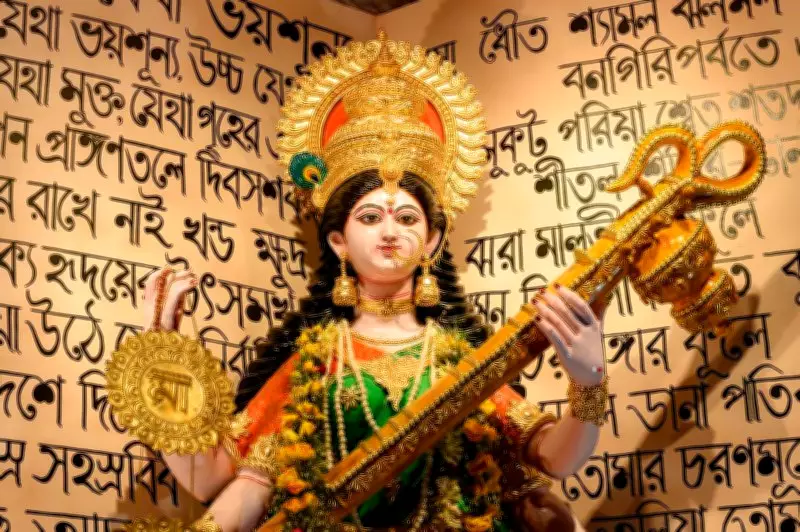
- Artistic depictions show Saraswati holding a veena, symbolizing music, while Vagdevi is rarely iconographically represented.
- Literary references from the Mahabharata and Ramayana show Saraswati as a prominent figure, while Vagdevi appears less frequently.
Modern Interpretations
In contemporary Hinduism, the distinction between Vagdevi and Saraswati is largely forgotten. However, scholars continue to study this merger to understand the dynamics of religious change. Some see it as a natural evolution where specialized deities give way to more universal ones, while others view it as a deliberate theological consolidation.
Ultimately, the story of Vagdevi merging into Saraswati is a testament to the fluidity and adaptability of Hindu mythology. It shows how ancient cultures reinterpreted their gods to meet changing spiritual needs, ensuring their relevance across millennia.