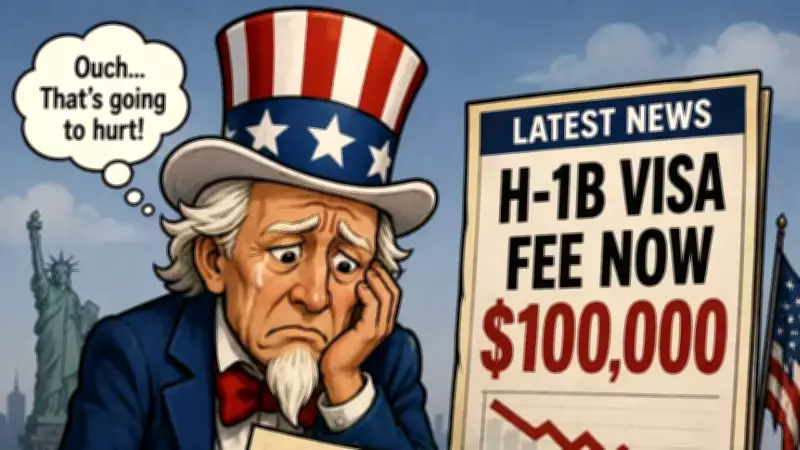
A federal judge in Massachusetts has struck down former President Donald Trump's controversial $100,000 fee on certain new H-1B visas, ruling that the administration lacked the legal authority to impose what amounted to an unauthorized tax. The decision, issued by U.S. District Judge Leo Sorokin, marks a significant judicial setback to Trump's broader efforts to restrict legal immigration through executive action.
The Ruling
On Monday, Judge Sorokin ruled that the $100,000 payment required by Trump's September 2025 proclamation went far beyond charges authorized by Congress. "Here, the substance and application of the $100,000 payment reveal that it is a tax, regardless of what the payment is called," the judge wrote. He emphasized that only Congress has the power to impose such a levy.
The fee, introduced under the proclamation titled Restriction on Entry of Certain Nonimmigrant Workers, was set to apply to new H-1B petitions filed on or after September 21, 2025. The Trump administration argued it was necessary to protect American jobs and curb abuses of the visa system. However, the court found that the fee effectively created a new tax without congressional approval, exceeding the president's authority under the Immigration and Nationality Act.

Legal Challenge
The case was triggered by a coalition of 20 Democratic state attorneys general who challenged the fee. They argued that the steep increase would discourage companies from sponsoring skilled foreign workers and harm state economies, universities, hospitals, and technology industries that rely heavily on H-1B talent. Judge Sorokin agreed with these concerns, noting that the policy would cause widespread disruption across essential sectors such as education and healthcare.
Impact on Indian Workers
Indian professionals dominate the H-1B system, accounting for nearly 70% of all beneficiaries. According to U.S. Citizenship and Immigration Services data, roughly 73% of H-1B workers whose applications were approved in fiscal 2023 were born in India. The fee would have made it significantly more expensive for employers to hire these workers, potentially reducing opportunities for global talent.
Rajiv Dabhadkar, founder of the National Organisation for Software and Technology Professionals (NOSTOPS), described the fee as economic exclusion disguised as immigration reform. "The $100,000 fee was not immigration policy, it was economic exclusion dressed in legal language. The court has correctly identified it as an unauthorized tax," he said. He added that the ruling preserves the viability of the H-1B program as a channel for global talent.
Industry Concerns
Employers argued that a $100,000 charge per H-1B worker would fundamentally alter hiring decisions across sectors. Large technology companies might absorb the expense, but startups, universities, hospitals, and mid-sized businesses would face severe constraints. Many employers might stop sponsoring foreign workers altogether, reducing opportunities for skilled professionals from countries like India and China.
The H-1B visa program, created in 1990, allows U.S. employers to hire foreign professionals in specialty occupations requiring at least a bachelor's degree. It is widely used by technology companies to recruit engineers and coders. Each year, the U.S. issues 65,000 regular H-1B visas, plus 20,000 for applicants with advanced U.S. degrees. Demand far exceeds supply, leading to a lottery system.
Administration Response
The Department of Homeland Security criticized the ruling, calling it judicial overreach. A DHS statement said it disagreed with "this blatant judicial activism dismantling President Trump's historic efforts for immigration reform." Trump also reacted sharply, saying federal judges were "really giving us a hard time" and "hurting our country very badly." White House spokeswoman Taylor Rogers said the administration was confident the ruling would be overturned on appeal.

What Happens Next
The Massachusetts court's decision blocks the $100,000 fee nationwide for now. However, the legal battle is far from over. The Trump administration has indicated it will appeal. In a separate case, a federal judge in Washington previously upheld the fee, creating a legal split. The outcome will depend on higher courts, including the U.S. Court of Appeals for the First Circuit. For now, the ruling offers relief to employers, universities, and foreign professionals who rely on the H-1B program to work in the United States.
Gil Guerra, an immigration policy analyst at the Niskanen Center, noted that because the fee applied only to new H-1B recipients, it was more likely to cause medium- and long-term labor shortages rather than immediate disruption. The decision underscores the ongoing debate over immigration policy and the balance between executive authority and congressional power.