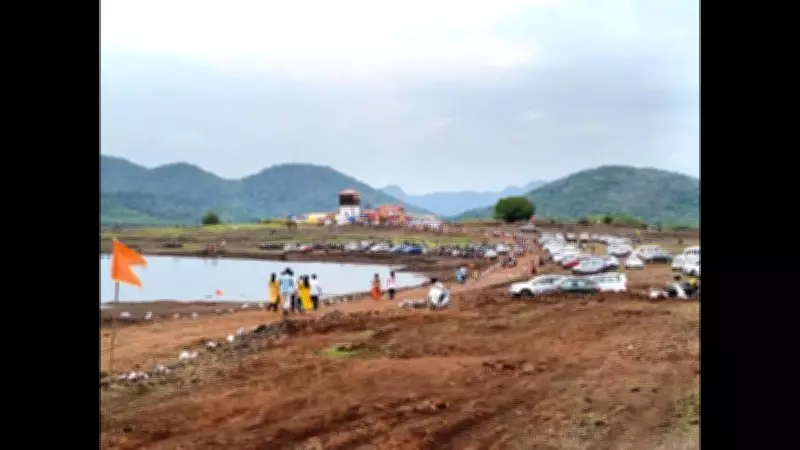
Kurdi: The Selaulim dam swallowed Kurdi whole. It took the houses, the roads, the river crossings, the culverts, the smells and the sounds of an entire village — and buried them all under its reservoir. Every summer, for a few precious weeks, as the water recedes, Kurdi rises.
On Sunday, thousands made the pilgrimage to the Someshwar temple for the annual Shree Someshwar Utsav — the swayambhu linga in the sanctum sanctorum of the temple has endured nearly four decades of submergence and remains intact. For the displaced inhabitants of Kurdi, it was less a festival than a homecoming.
Gajanan Kurdikar is now 82, but standing amid the ruins of his village, his eyes light up like those of a young man. He is transfixed—by the remnants, by the memories, by the weight of what was lost here. He spots the ruins of the Betal temple and points. “And here was the Betal temple, the guardian deity of our village,” he says. Then, his voice dropping: “Right outside this temple, under the shade of a huge mango tree, Bhausaheb (Dayanand Bandodkar, Goa’s first chief minister) addressed the villagers when he came with the proposal of constructing the dam that would eventually uproot us from the village of our forefathers.” He pauses, his voice catching. “I was hardly 25 years old then. He gently placed his hand on my shoulder and held aloft a vision of a better future.”

Ajay Kurdikar was 14 when his family left. However, the pull of this place has still not loosened its grip. “This is the only time of the year that Dev Someshwar resurfaces to offer darshan to his bhakts here,” he says. “The utsav enables the original Kurdikars to soak in nostalgia and get reconnected to their roots.”
Manoj Paryekar stays at the water’s edge and points to a spot in the shimmering expanse beyond. “My house has gone under water. There it was,” he says. Then, after a pause: “The memories of the house and the village lie deep in the recesses of my heart. I make it a point to come here and bathe in memories at least two or three times before the village loses itself in the water again.”
For Kamlakant Kurdikar, the village lives in the memory of a river that once divided it, and a canoe that crossed it. His family ferried people from one bank to the other. “There were very few houses near the temple,” he recalls. “The river ran across the village, dividing it.” He sought rehabilitation in govt service after displacement, but every plea was turned down. The loss was double — of the village, and of the life that was promised after it.
Over 3,000 villagers from Kurdi and Selaulim were uprooted when the Selaulim irrigation project finally came to fruition in the early 1980s, resettled in distant Valkini and Vaddem.
Aartis were sung, prayers offered and mahaprasad was distributed. Elderly men found old friends. Children saw, perhaps for the first time, what their ancestors’ village once looked like.
And then, as it does every year, Kurdi began its wait for the rains to take it underwater once again.