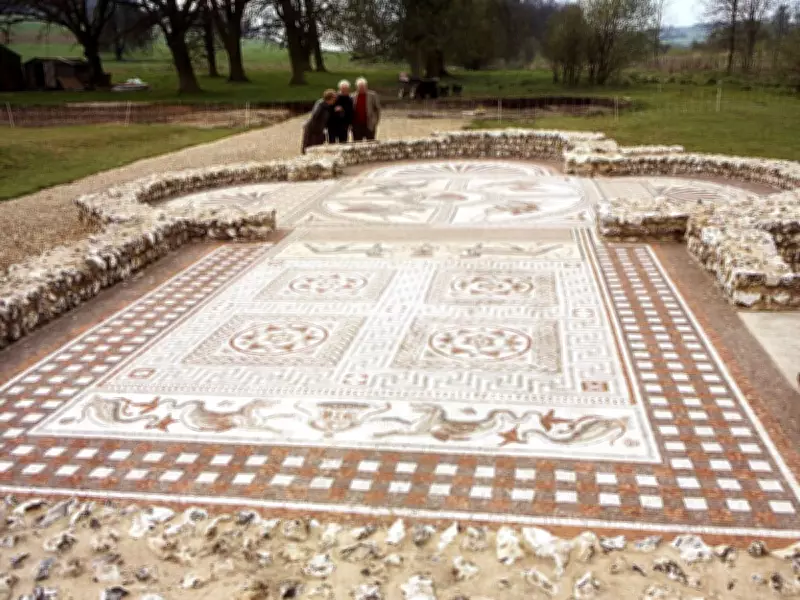
A Roman mosaic found in rural Wiltshire has brought new focus to the question regarding Britain's history following the end of the Roman Empire: what happened to the people and places that remained behind.
Roman Villas: Symbols of a Vanished World
Across Britain, Roman villas have long been treated as symbols of a vanished imperial world. However, in recent years, archaeologists increasingly believe that the abandonment of these properties did not occur immediately after the collapse of the empire. Some sites may even have been modified over time for ongoing use. The growing discussion on this topic has been fed by evidence found in southern England, where remarkably preserved villa remains continue to emerge beneath farmland and private land.
Why Roman Villas Matter
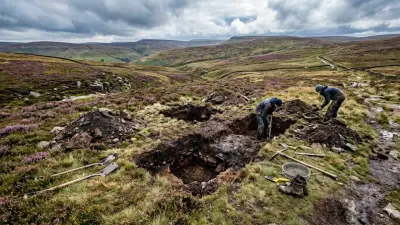
The Roman villas found in Britain were not just homes for country residences. They also served as centres of farming, administration, and wealth. As noted by Cardiff University, the most recent excavation of a Roman villa complex in the Chalke Valley of Wiltshire discovered an extensive complex that included mosaics, wall paintings, a bathhouse, and a number of impressive stone buildings. This excavation team viewed the villa as an essential part of a wealthy rural estate that existed in the later days of Roman Britain. The Cardiff University excavation, carried out with local volunteers and Teffont Archaeology, showed much evidence of how much of Roman Britain was buried beneath the English soil. The presence of geometric mosaics and paintings at this location indicated the grandeur of Roman Britain, which had been located in these estates. Discoveries such as these are particularly interesting not only because of their artistic value but also because of their preservation of architectural structures. Today's archaeologists are more interested in studying the evolution of Roman villas than considering them frozen remains.

A More Complex End to Roman Britain
This change of attitude can be seen through research conducted by experts on yet another significant site of a British villa in Rutland. According to the University of Leicester, besides a fabulous mosaic of scenes from the Trojan War uncovered during the excavation of the Rutland Roman villa, archaeologists also discovered that portions of the building had been renovated several times throughout its history. It has been noted that the significance of this finding did not only lie in the discovery of the mosaic but in the well-preserved nature of the site itself, including various renovations. There were signs that certain sections of the building were used for different purposes after losing their original value. The reason this is important lies in the fact that historical interpretations toward the end of Roman Britain were based on the concept of a rapid downfall. In a study, scholars examined through their investigation of continuity in settlements around the late Roman Empire that in some places, the pattern of settlement continued despite the waning strength of the Empire without suffering from any interruption. While the study was not focused specifically on Wiltshire, it supports a wider scholarly view that Roman influence often faded gradually.
Landscapes That Survived Political Change
One of the key reasons why villa findings continue to be so relevant is that they offer valuable information during times of uncertainty and transition. Mosaics can reveal far more than artistic taste. They can also reveal how certain spaces were used and what image owners wanted to portray. The use of wall plaster, central heating, and baths also gives hints at investments made by owners and their social standing within communities. During their investigations of the Rutland villa, researchers from the University of Leicester found evidence that the site had developed over time. Some parts of the building had been remodelled and adapted in subsequent phases of its development. According to researchers, some spaces had deteriorated, but it also seemed like some had been recycled for a while before the villa was left deserted. Instead, some estates may have continued functioning in altered ways, even as political authority changed.

Hidden Beneath Modern Ground
These discoveries in Wiltshire also illustrate how many aspects of Roman archaeology remain buried beneath contemporary Britain. According to reports, the excavations at the Chalke Valley site marked the first discovery of a Roman villa of its kind in south Wiltshire. Many sites are likely buried under today's fields, gardens, and villages because construction in later periods caused little damage. Many discoveries are made inadvertently because of farm ploughing or utility works. The investigations that follow reveal the feature found at first to be just a small component of a greater landscape. That is why preserved villas are of significant interest to academics. It is when buildings remain with all their floors, walls, and structures intact that it is possible to study their history of use and reconstruction for centuries.
A Discovery That Changes Bigger Debates
Instead of seeing Roman civilisation in Britain ending suddenly, these kinds of findings can suggest continuity, adaptation, and transformation rather than total disappearance. These sites can imply that the buildings left by the Romans as part of their legacy could continue to be used even when they ceased to be politically relevant. Archaeologists are very careful when making generalised assumptions from archaeological discoveries. Not all sites where the Romans lived were necessarily used by other civilisations later. Still, the findings uncovered by archaeologists in both Wiltshire and Rutland are helping historians reconstruct the period between Rome's departure from Britain and its new settlement by the Anglo-Saxons. What remains under the soil is a reminder of Roman civilisation, but it is also a reminder of how people adapted to changes brought by the end of the Roman Empire era.