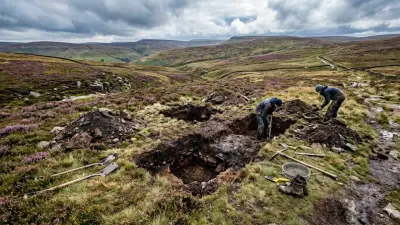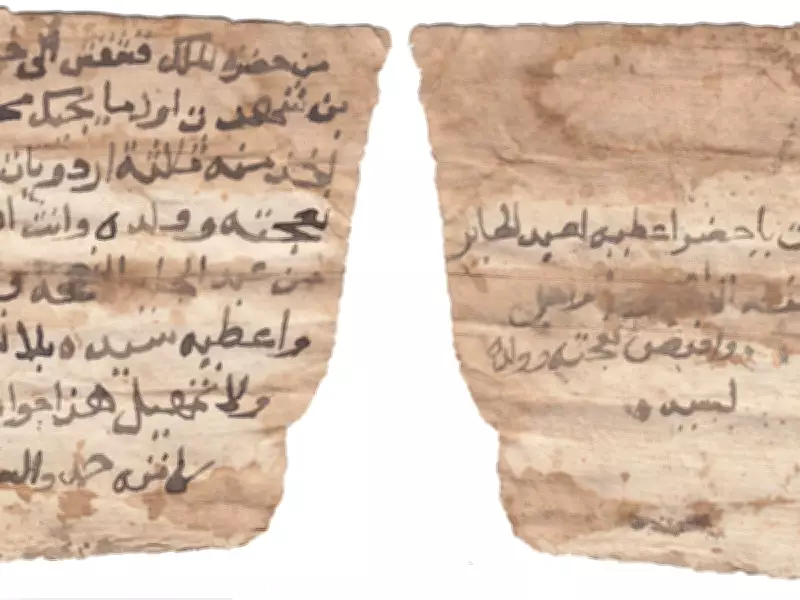
An ancient and heavily damaged Arabic document unearthed in northern Sudan has confirmed the existence of King Qashqash, a Nubian ruler who had long hovered between history and legend. This piece of paper was discovered during excavations in Old Dongola, once the capital of the Kingdom of Makuria. Historians had previously relied on legends and religious texts to determine whether King Qashqash had ever ruled, and now have finally been presented with historical evidence suggesting that he did rule the city of Dongola between the 16th and 17th centuries.
In a recent study published in the journal Azania: Archaeological Research in Africa, a fragment of an Arabic document along with 20 other fragments of letters and records related to law and administration of the House of the Mekk were analyzed using various scientific techniques, including radiocarbon dating and studying historical documents.
A Routine Order with Extraordinary Importance
The document itself looks rather mundane on the surface. Written in Arabic, it records an administrative order involving the exchange of textiles for livestock. Yet its historical value lies in the fact that the instruction was issued in the name of "King Qashqash." According to reports, the order was dictated by the king's messenger Hamad to his subordinate Khidr. It stated that Khidr should accept three measures of textiles from a man named Muhammad al-Arab in exchange for the ewe and her lamb purchased from another person named Abd al-Jabir. It is noteworthy that despite the seemingly uneventful nature of the text, it provides insights into the role of the king in the everyday administration of the region. As stated by the researchers, this document gives us "an unusual insight into the micropolitics of Dongola."

Moreover, there is some text on the back side of the paper too; however, many elements are missing due to the damaged condition of the document. The researchers suggested it had something to do with either cotton or head coverings.
Filling Gaps in Nubian History
Old Dongola was an ancient city built close to the eastern banks of the River Nile in contemporary Sudan. Served as the capital of Makuria, it was one of the most important Christian kingdoms in medieval Africa. Many archaeological findings about this kingdom have given historians enough information on the earlier years. However, records of subsequent periods after the kingdom's fall in the 14th century became extremely scarce.
Due to the scarcity of evidence, individuals such as Qashqash were largely mentioned in oral accounts and hagiographic literature, such as the Kitāb al-Ṭabaqāt, a 19th-century book comprising stories about Sudanese religious personalities. Historical scholars had always been divided on whether Qashqash was a real individual or a creation of legends. The newly studied document changes that picture.
In their conclusions, the authors stated that the finding "represents a rare instance in which a figure previously confined to the domain of hagiographic literature and oral traditions can be situated within a verifiable historical framework supported by tangible archaeological evidence."
Clues from the House of the Mekk
This paper was found in Building A.1 of Old Dongola, known locally as the House of the Mekk. The archaeologists assumed that the building was used by a ruler due to its grandeur, the complexity of its architecture, and the luxurious artifacts found during excavations. During the excavations, among other things, the experts discovered textiles, jewelry, leather shoes, bullets for a gun, and a dagger handle made of ivory or rhinoceros horn. Thus, despite the fall of the Makurian kingdom, Dongola remained politically and economically significant.
As for the dating of the found paper, the archaeologists considered the findings of coins in the same layer and the radiocarbon dating of organic matter found near it. Though it is hard to determine the exact date of the paper, one may suppose that it was created in transition from the 16th to the 17th century.
For historians of Nubia, the significance of the find lies not only in proving Qashqash's existence but also in offering a rare written glimpse into a period that has long remained obscure.