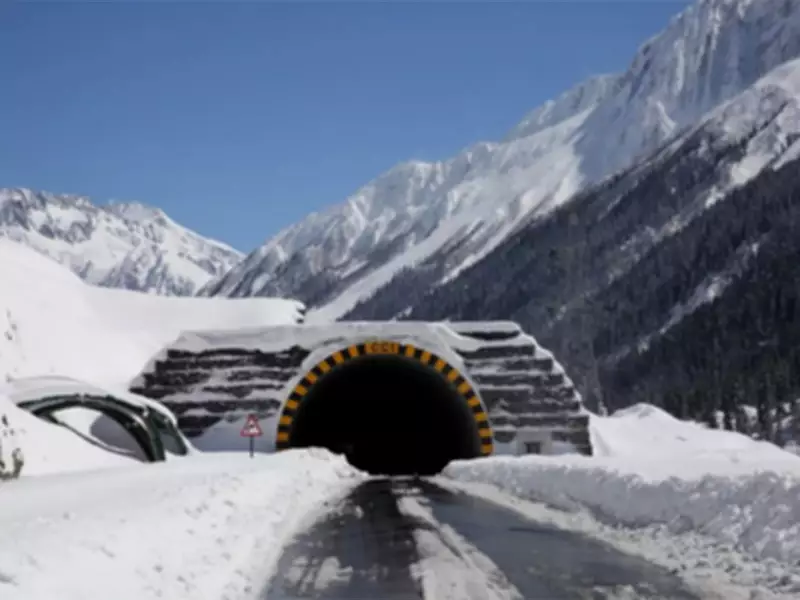
The strategically significant Zojila Tunnel project has achieved a major milestone as the two ends of the tunnel have been connected, forming a single 13-kilometer-long passage beneath the Zojila Pass in Jammu and Kashmir. This tunnel, being constructed by the National Highways and Infrastructure Development Corporation Limited (NHIDCL) at an estimated cost of around Rs 6,500 crore, will provide all-weather connectivity between the Kashmir Valley and Ladakh, effectively ending the annual disruptions caused by heavy snowfall at the Zojila Pass, where temperatures can drop to minus 35 degrees Celsius.
Historical Context and Strategic Importance
For decades, the Zojila Pass remained closed for nearly 160 to 180 days each year, isolating Ladakh from the Kashmir Valley. While improved snow clearance and road maintenance have reduced closure periods in recent years—35 days in 2024, 32 days in 2025, and 73 days in 2026—connectivity remained weather-dependent. Once operational, the tunnel will eliminate one of the biggest logistical challenges faced by both civilians and the armed forces.
The Srinagar-Leh highway passing through Zojila is the primary supply route for troops deployed in Ladakh, including those stationed in the Siachen Glacier region and along the Line of Actual Control (LAC) with China. This route holds historical significance, as during the 1999 Kargil conflict, Pakistani forces targeted areas overlooking this highway in an attempt to disrupt India's military supply chain to Kargil and Ladakh. Defence planners view uninterrupted access through Zojila as critical for sustaining military deployments, moving equipment, and ensuring rapid reinforcement of forward areas.

Travel Time Reduction and Infrastructure Benefits
The horseshoe-shaped, single-tube tunnel will be 9.5 meters wide, 7.57 meters high, and 13 kilometers long. Once completed, it will reduce travel time across the Zojila stretch from approximately 90 minutes to just 15 minutes. Together with the recently inaugurated Z-Morh Tunnel, the project will provide seamless all-weather connectivity on the Srinagar-Leh National Highway. It will also improve access to Baltal, the base camp for the annual Amarnath Yatra. The tunnel is expected to become operational in 2028.
Part of a Wider Border Infrastructure Push
The Zojila Tunnel is one of 31 border road tunnels currently under construction in Jammu and Kashmir and Ladakh—20 in Jammu and Kashmir and 11 in Ladakh. These projects form part of a broader network of 73 border infrastructure projects aimed at strengthening connectivity and military preparedness along the frontier with China. The push gained momentum after the 2020 Galwan Valley clash, which underscored the importance of rapid troop mobilisation and reliable logistics in high-altitude regions. In recent years, the government has sharply increased funding for border infrastructure, enabling faster construction of roads, tunnels, and bridges by agencies such as the Border Roads Organisation.
Beyond their military significance, these projects are expected to improve year-round mobility, boost economic activity, enhance access to healthcare and education, and strengthen India's presence in remote Himalayan regions along the border.