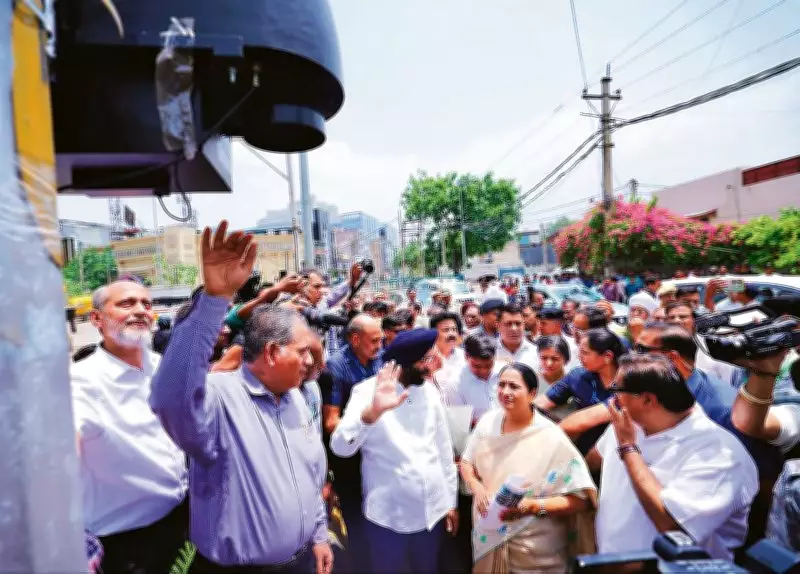
Delhi Chief Minister Rekha Gupta on Tuesday inspected two indigenous anti-pollution pilot projects in the national capital, emphasizing the government's commitment to tackling air pollution through homegrown solutions. The projects, developed under the 'Made in India' initiative, aim to reduce particulate matter levels using innovative technologies.
Indigenous Technologies Under Review
The first project involves a large-scale air purification system installed at a busy intersection in Central Delhi. The system uses a combination of filtration and electrostatic precipitation to capture PM2.5 and PM10 particles. The second project is a mobile air quality monitoring van equipped with real-time sensors and a prototype of a road dust suppression system.
During the inspection, CM Gupta interacted with scientists from the Indian Institute of Technology (IIT) Delhi and the National Environmental Engineering Research Institute (NEERI), who are leading the projects. She stressed the importance of scaling up successful pilots to cover more areas of the city.

Government's Stance on Air Pollution
Rekha Gupta stated, 'Delhi has been grappling with severe air pollution for years. These indigenous projects demonstrate our ability to develop cost-effective solutions that can be deployed rapidly. We are committed to supporting such innovations and integrating them into our broader clean air action plan.'
The Delhi government has allocated a budget of Rs 50 crore for the pilot phase, with plans to expand based on performance data. The projects are expected to be operational for six months before a final assessment.
Expert Reactions
Environmental experts have welcomed the move but called for a comprehensive approach. Dr. S. K. Sharma, an air quality specialist, said, 'While these technologies are promising, they must be part of a larger strategy that includes reducing vehicular emissions, controlling dust from construction sites, and curbing stubble burning in neighboring states.'
The inspection comes ahead of the winter season when Delhi's air quality typically deteriorates due to meteorological conditions and external factors like crop residue burning. The government has also announced stricter enforcement of the Graded Response Action Plan (GRAP) this year.
Future Plans
The CM indicated that the government will consider deploying similar systems in other pollution hotspots, including Anand Vihar, ITO, and Dwarka. Additionally, the government plans to launch a public awareness campaign to encourage citizen participation in pollution control measures.
The 'Made in India' tag is a strategic push to reduce dependence on imported technology and promote local manufacturing. The projects align with the central government's Atmanirbhar Bharat (Self-Reliant India) initiative.