Uranus' Moons Could Reveal Ancient Planetary Disasters
For years, astronomers believed that our solar system's eight planets (nine, including Pluto) were the complete set. However, a growing body of evidence suggests that the early solar system was far more chaotic, possibly containing one or two additional giant planets that were ejected into deep space. Now, researchers think the clues to these missing worlds may be found in the frozen, battered moons orbiting Uranus, which have long been overshadowed by the more prominent satellites of Jupiter and Saturn.
The Case for Missing Planets
The idea of missing planets is not as far-fetched as it sounds. Scientists have long suspected that Jupiter, Saturn, Uranus, and Neptune did not form in their current orbits. During the early stages of the solar system, these gas giants migrated and interacted gravitationally, leading to a period known as the giant planet instability. Some models predict that one or two extra ice giants, similar in size to Uranus or Neptune, were flung out of the solar system entirely during this chaotic phase.
Uranus: An Oddball Planet
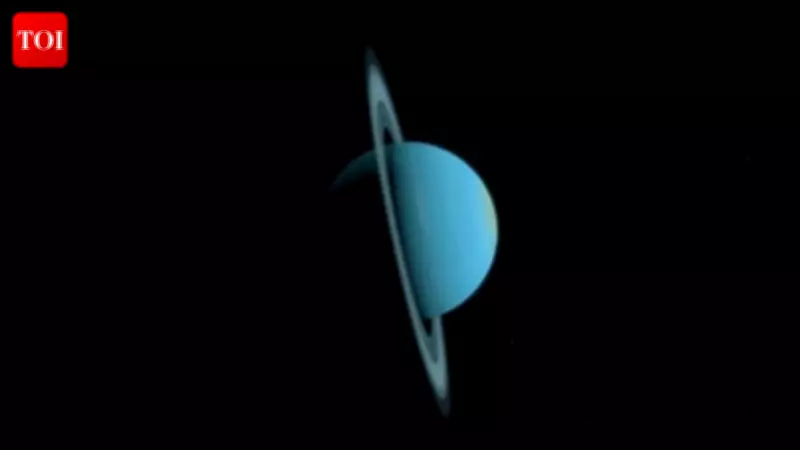
Uranus has always been peculiar, rotating on its side with its poles nearly aligned with its equator. This extreme tilt is thought to result from a massive impact, but new research suggests the planet experienced even more dramatic events. A recent study published in Icarus, as reported by Wired, involved over 100 computer simulations—122 to be exact—to examine how Uranus' moons would have fared during the solar system's tumultuous youth. In most simulations, the moons did not survive; their orbits were disrupted, or they were destroyed. Yet, Uranus' moons remain intact today.

How Did Uranus' Moons Survive?
The researchers concluded that the current configuration of Uranus' moons could only have arisen from a period of violent instability. This chaos, which likely destroyed and re-formed the moons, is only observed in models that include more giant planets than currently exist. The findings point to a scenario where additional planets once orbited the Sun but were later ejected.
Miranda: A Reconstructed Moon
Among Uranus' five major moons, Miranda stands out as the smallest and most bizarre. Its surface is a patchwork of cliffs, ridges, and broken terrain, resembling a body that was shattered and haphazardly reassembled. Astronomers have long speculated that Miranda was destroyed and rebuilt at some point. The latest research strengthens this hypothesis. If Miranda is indeed a reconstructed world, it could serve as one of the oldest and most peculiar witnesses to the solar system's most chaotic era.
Hidden Moons in Uranus' Rings
Miranda may not be the only clue. Scientists suspect that Uranus' rings contain numerous tiny, hidden moons, or moonlets, which create ripples and waves in the ring patterns. Outer rings also hint at gravitational influences from undiscovered objects. Each new moon discovered could provide additional insights into Uranus' violent past and the lost planets that once existed.
Future Missions to Uranus
The biggest challenge is our limited knowledge of Uranus. Only NASA's Voyager 2 spacecraft has flown past the planet, in 1986—nearly 40 years ago. However, this may change soon. NASA and the European Space Agency are reportedly planning missions to Uranus in the 2040s. These missions could offer the first close-up observations of Miranda and other moons, potentially revealing whether they are ancient survivors of planetary mayhem.
If the moons do preserve evidence of vanished planets, it would not only rewrite the history of our solar system but also transform our understanding of planet formation across the universe. For now, the mystery remains unsolved. But in the cold, dark shadows around Uranus, the battered moons continue to spin, silently guarding the secrets of worlds that once were and are no more.