

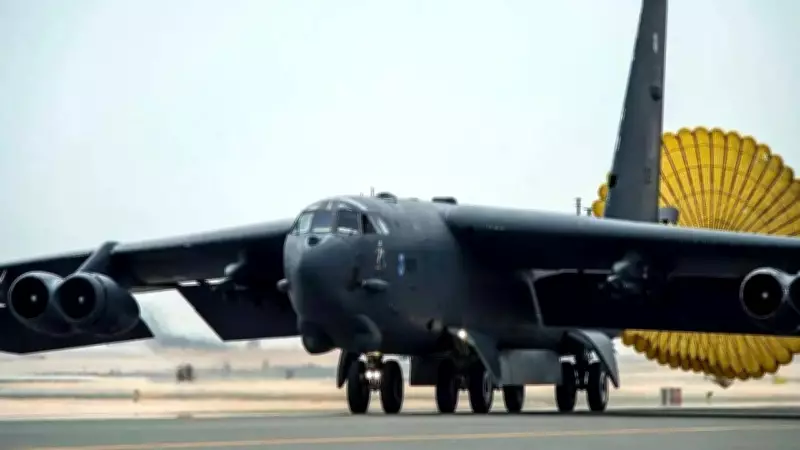
A US Air Force B-52 Stratofortress bomber tragically crashed at Edwards Air Force Base in California on June 15, killing all eight personnel on board. The aircraft was participating in a radar modernization test mission when it crashed shortly after takeoff.
A Storied History of Service
Entering service in 1955, the Boeing B-52 remains the most numerous bomber and one of the most important aircraft in the US Air Force bomber fleet. Currently, the US operates 76 B-52H bombers after more than 70 years of operational history.
The B-52 has been part of every major US military operation since its induction. It first saw combat over the jungles of Vietnam and served as a key pillar of the US nuclear deterrent throughout the Cold War. The bomber took part in operations over the Balkans during the Kosovo conflict, the US-led wars in Afghanistan and Iraq, and the campaign against ISIS in Iraq and Syria.

Recent Operations Against Iran
Recently, the B-52 took part in Operation Epic Fury against Iran. Initially, the B-52 conducted long-range strikes from outside Iranian airspace, but with the US Air Force gaining air superiority over most of Iranian territory, the bombers began conducting overland missions directly over Iranian territory.
"Given the increase in air superiority, we've successfully started to conduct the first overland B-52 missions, which allow us, as we've before, to continue to get on top of the enemy," General Dan Caine, Chairman of the Joint Chiefs of Staff, said at a news conference alongside Defence Secretary Pete Hegseth.
Modernization and Future
Despite its age, the B-52 remains central to US military planning. The US Air Force is currently modernizing the fleet with new Rolls-Royce F130 engines, advanced radar systems, and upgraded avionics. These upgrades are intended to keep the bomber operational into the 2050s.
B-52 Stratofortress Specifications
- The B-52 has an operational range of about 14,000 kilometers, depending on the payload weight.
- It is currently powered by eight Pratt & Whitney TF33-P-3/103 turbofan engines, each producing up to 17,000 pounds of thrust.
- The bomber weighs approximately 185,000 pounds (83,000 kilograms) and has a maximum takeoff weight of 488,000 pounds (219,000 kilograms).
- The B-52 carries a payload of 70,000 pounds (31,500 kilograms), allowing it to carry a wide range of conventional and nuclear weapons.
- It can carry munitions including JDAM laser-guided bombs, AGM-158 (JASSM), and AGM-86B (ALCMs).
The B-52 has remained relevant across generations of warfare and has outlived multiple adversaries. It adapted for precision-guided weapons and network-centric warfare during the course of its service.






