

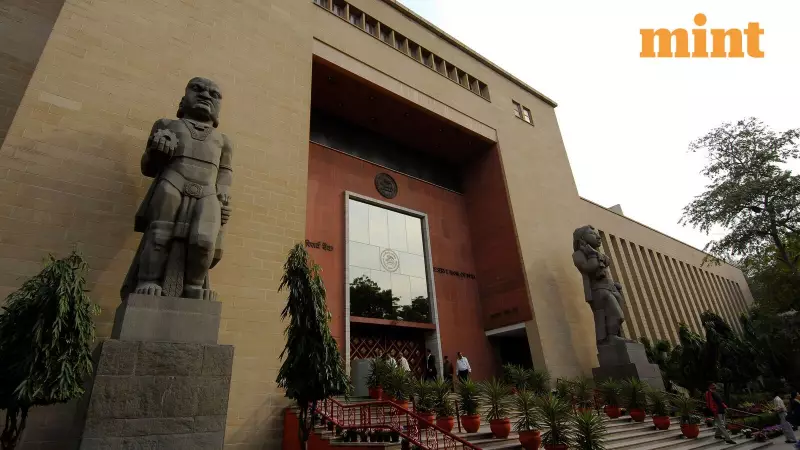
The Reserve Bank of India (RBI) has reported a significant 13.55% increase in consumer grievances received under its integrated Ombudsman scheme for the financial year 2024-25. This single-window grievance redressal mechanism handles complaints against banks, non-banking financial companies (NBFCs), payment system operators, and credit information companies.
Key Statistics and Complaint Trends
During the last fiscal year, the RBI's Ombudsman offices received over 13.34 lakh complaints, a notable jump from the previous year. The data reveals that complaints against regulated entities were submitted via email, physical letters to the Centralised Receipt and Processing Centre (CRPC), or through the online Complaint Management System (CMS) portal.
Banks bore the brunt of public dissatisfaction, accounting for a staggering 81.53% of all complaints, which translates to approximately 2.41 lakh cases. NBFCs followed, responsible for 14.80% (around 43,800 complaints). A notable shift occurred within the banking sector: the share of complaints against private sector banks rose to 37.53% in FY25 from 34.39% in FY24. Conversely, grievances against public sector banks, which had the highest share previously, declined from 38.32% to 34.80%.

What Are Consumers Complaining About?
The category-wise breakdown of complaints highlights the primary pain points for Indian consumers. Issues related to loans and advances topped the list, constituting 29.25% of all grievances. This was closely followed by problems concerning credit cards (17.15%), mobile and electronic banking (16.86%), and the opening of deposit accounts (16.84%).
Geographically, metropolitan cities generated the highest volume of complaints at 45.86%. Urban, semi-urban, and rural areas contributed 25.64%, 18.46%, and 10.04% of complaints, respectively.
Redressal Efficiency and Public Outreach
Despite the surge in complaints, the disposal rate saw a slight dip. The rate declined from 95.10% in the previous year to 93.07% in FY2024-25. The Offices of the RBI Ombudsman (ORBIOs) handled a total of 3.12 lakh complaints during the year, which included a carry-over of 14,667 from FY24. Of these, approximately 2.90 lakh complaints were resolved.
The RBI's dedicated toll-free Contact Centre (14448) also witnessed increased activity, receiving 9,27,598 calls in FY25 compared to 7,19,694 calls in the preceding year. The majority of these calls (60.64%) were handled by the Interactive Voice Response System (IVRS), while customer care personnel directly attended to 38.59% of the queries. Only a minimal 0.78% of calls were abandoned.
How to File a Complaint with the RBI Ombudsman
For consumers facing issues with their financial service provider, the RBI has outlined a clear process:
- First, you must formally lodge a complaint directly with the concerned bank, NBFC, or other regulated entity (RE).
- If the RE does not reply within 30 days, or if it rejects your complaint wholly or partially, you can escalate the matter to the RBI Ombudsman.
- To file online, visit the official RBI website and navigate to the grievance redressal section or directly access the Complaint Management System portal.
- On the CMS portal, click the prominent orange button to begin the process. You will need to verify your identity via a mobile OTP after entering basic details.
- Finally, fill in the detailed complaint form with your address, the name of the organisation, and a description of the issue.
This structured approach ensures that all avenues for resolution within the concerned institution are exhausted before the central banking authority steps in, promoting efficient grievance redressal across India's financial landscape.






