

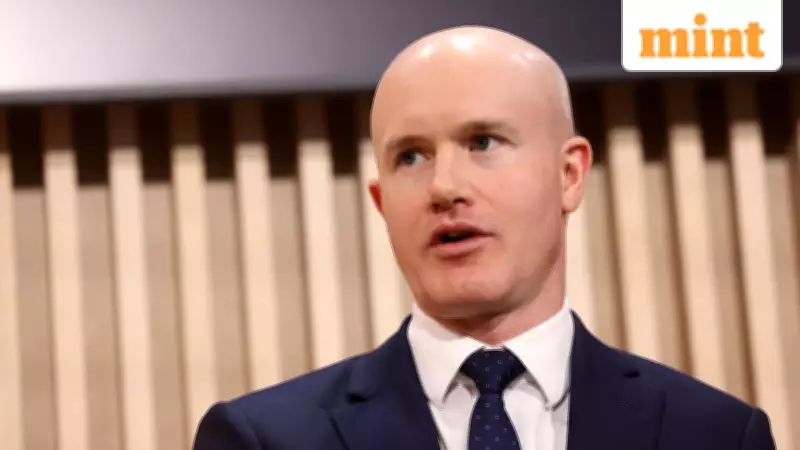
The Crypto CEO Who's Become Enemy No. 1 on Wall Street
Brian Armstrong, the co-founder and chief executive officer of Coinbase Global Inc., finds himself at the center of a high-stakes confrontation with Wall Street's most powerful banking figures. The clash represents a fundamental battle over the future of finance as cryptocurrency moves swiftly into the American mainstream.
A Davos Confrontation That Shook Financial Circles
During last week's World Economic Forum in Davos, Armstrong was having coffee with former UK prime minister Tony Blair when JPMorgan Chase's Jamie Dimon abruptly interrupted. "You are full of s—," declared Dimon, a longtime crypto skeptic who previously called bitcoin a fraud, pointing his index finger directly at Armstrong's face. According to people familiar with the exchange, Dimon essentially told the Coinbase CEO to stop lying on television.
The confrontation stemmed from Armstrong's appearances on business-television programs earlier that week, where he had accused banks of attempting to sabotage legislation that would establish a new regulatory framework for digital assets. This dramatic encounter highlighted the growing tensions between traditional financial institutions and the expanding crypto industry.

The Core Conflict: Banking Deposits vs. Crypto Rewards
At the heart of this battle lies a fundamental question: Should cryptocurrency exchanges be permitted to offer consumers regular payouts for holding digital tokens? These so-called rewards would provide holders of stablecoins—digital assets pegged to real-world currencies like dollars—with recurring fees, potentially around 3.5%.
Banks argue these payouts effectively function as interest on bank accounts. With traditional checking accounts typically offering yields under 0.1%, financial institutions worry consumers will shift their money in droves into crypto alternatives. This migration, banks contend, could compromise community banks and business lending capabilities.
Armstrong and other crypto advocates counter that the free market should prevail. They suggest banks could simply pay higher interest rates to compete with stablecoins or enter the stablecoin business themselves. "There's no reason to prohibit paying interest to consumers," Armstrong stated in an interview last year.
The Legislative Battlefield: Clarity Act and Political Maneuvering
The proposed legislation, known as the Clarity Act, might shape the future of everyday financial services, including bank deposits and electronic payments. This regulatory framework has become the focal point of intense lobbying from both sides.
Armstrong has taken a firm stance, declaring on social media platform X: "We'd rather have no bill than a bad bill." His position came just before a Senate committee was poised to vote on a version that could effectively ban companies like Coinbase from offering yield to customers—a move potentially costing the exchange billions of dollars. Within hours, the vote was abruptly postponed, surprising much of the financial world.
"It's now seen more as Coinbase vs. the banks rather than crypto vs. the banks," observed Ron Hammond, head of policy and advocacy at digital assets trading firm Wintermute.
Wall Street's Cold Shoulder and Banking Resistance
Armstrong's advocacy didn't end with his social media post. He echoed his views in television appearances, telling Bloomberg that bank lobbyists were "out there trying to ban their competition" and accusing banks of lending out customer deposits "without their permission essentially."
This stance led to a series of uncomfortable encounters with bank CEOs at Davos. Bank of America chief executive Brian Moynihan told Armstrong during a cordial but somewhat stilted meeting: "If you want to be a bank, just be a bank." Citigroup's Jane Fraser gave Armstrong less than a minute of her time, while Wells Fargo CEO Charlie Scharf offered nothing at all, telling Armstrong there was nothing for them to discuss.

From Shy Founder to Crypto's Willing Spokesman
Armstrong, who studied economics and computer science at Houston's Rice University, was an early convert to digital money and blockchain technology. After reading the original bitcoin white paper published in 2008 by the pseudonymous Satoshi Nakamoto, and experiencing difficulties sending money to South America while working for Airbnb in 2011, he co-founded Coinbase in 2012.
Former colleagues previously described Armstrong as shy, sometimes struggling to communicate with employees and uncomfortable when reprimanding staff. Some thought he acted like a Vulcan from "Star Trek," known for their stoicism. However, Armstrong has been far from bashful about his ambitions for Coinbase, which he has positioned as the American company to bring crypto into the mainstream.
"Ultimately we want to be a bank replacement for people," he declared on Fox Business last year. "We want to become a super app and provide all types of financial services."
Political Investments and Regulatory Battles
As Coinbase expanded, Armstrong poured millions into developing the industry's biggest lobbying effort. Following multiple crypto booms and busts, Coinbase went public in April 2021, briefly hitting a market value of $100 billion and pushing Armstrong's stake to approximately $13 billion.
After surviving industry collapses in 2022 and regulatory attacks under the Biden administration in 2023, Armstrong fought back—and found his voice. The reluctant public speaker who preferred coding with headphones on became the crypto industry's willing spokesman in Washington.
Coinbase invested approximately $75 million into the 2024 election through a network of super political-action committees, with the goal of fighting skeptical candidates. The company also established a grassroots organization to build public support for crypto legislation.
The Path Forward: Compromise or Continued Conflict?
In the latest push to find a compromise, the White House plans to host a meeting between bank and crypto industry groups, with Trump's AI and crypto czar David Sacks expected to attend. Coinbase's head of U.S. policy, Kara Calvert, is also slated to participate.
Armstrong has proposed potential solutions to the impasse, suggesting to Moynihan that a new class of stablecoin issuers could be allowed to pay rewards if they met tighter regulatory standards. This approach could theoretically allow banks to enter the market on a level playing field with Coinbase.
Others have proposed banning most reward payments while creating a narrow list of exempted uses for Coinbase and similar companies. Any legislative deal would likely need Armstrong's backing to move forward.
"It is Coinbase who is seen as the one who has to say yea or nay to this legislation," noted Hilary Allen, a professor of law at American University and securities laws expert. "That is a truly shocking state of affairs."
As the House of Representatives passed its version of the Clarity Act last year, the Senate faces a more difficult path due to disagreements over what rules crypto firms should follow. The Senate Agriculture Committee advanced its version recently, but lawmakers must still reconcile differences between chambers.
This ongoing battle between traditional finance and emerging crypto technologies represents more than just regulatory disagreement—it's a fundamental reimagining of how financial services might operate in the digital age, with Brian Armstrong positioned squarely at the center of this transformative conflict.





