

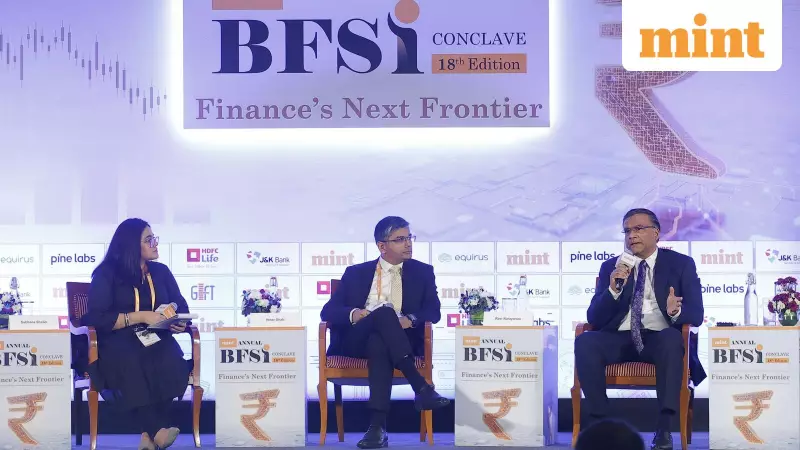
India's financial landscape is on the cusp of a significant transformation, as partnerships between regulated lenders like banks and non-banking finance companies (NBFCs) with fintech firms are poised for a major overhaul over the next three to five years. This was the consensus among experts during a panel discussion at the recent Mint BFSI Summit.
From Shortcuts to Sustainable Models
Panelists Ravi Narayanan, MD & CEO of SMFG India Credit Co. Ltd, and Nirav Shah, MD of Equirus Capital, argued that the nature of these collaborations will look drastically different. The era of shortcuts, such as balance-sheet renting or excessive credit guarantees, is ending. In its place, the future will be built on pillars of self-governance, better risk alignment, tighter unit economics, and robust user-data protection.
Narayanan distilled the core of evolving customer demand into three critical elements: "speed, transparency, trust." The winning business models will cater to a digital-first borrower who expects rapid decisions, clear communication, and absolute confidence in the security of their data and money.

The synergy is clear: fintechs contribute agility and a technology-first mindset, while NBFCs bring to the table trust, governance, and a sophisticated, nuanced understanding of risk and underwriting. However, Shah pointed out a fundamental challenge: the lack of a common data language. Fintechs are built to analyze vast behavioral data for credit distribution at scale, whereas NBFCs often rely on narrower, traditional datasets for assessment.
Navigating Tech Bottlenecks and Regulatory Shifts
Shah highlighted that technology constraints on the NBFC side frequently act as a brake on these partnerships. Despite fintechs promoting "low-code, no-code" integration capabilities, the reality of plugging into the legacy systems of large banks or NBFCs can still mean integration timelines stretching several months.
This evolution is occurring against a backdrop of deliberate regulatory tightening by the Reserve Bank of India (RBI). The central bank first introduced digital lending guidelines in September 2022, followed by detailed default loss guarantee (DLG) norms on 8 June 2023, which cap guarantees and define eligible providers. Furthermore, the co-lending rules issued in 2025 mandate proper risk-sharing, clear customer ownership, and full on-book loan recognition.
Narayanan framed this regulatory clean-up as a dual opportunity. If the RBI can streamline thousands of outdated circulars, regulated entities have a clear mandate to simplify their own internal processes and partnership frameworks with equal urgency. "The real shift... is from just risk sharing to true risk alignment," he stated, emphasizing that both partners must understand, price, and manage customer risk identically.
The Path Forward: Pricing, Discipline, and Maturity
Narayanan noted that co-lending has matured from an experiment to a mainstream business, estimating the market size at around ₹1.3 trillion and growing at 40–45% annually. As the model scales, remaining nuances will need to be ironed out.
Shah emphasized that pricing discipline will become a critical differentiator. He recalled a time when some players charged annualized interest rates exceeding 70%, which have since fallen to around 40% and may eventually settle in the 20% range. This compression makes product innovation and sustainable unit economics vital for survival.
He also issued a caution on balancing technology investment with human capital. Simply pouring hundreds of crores into platforms won't guarantee long-term competitiveness if it doesn't translate into real operational efficiency. The next phase of collaboration, the panelists concluded, will be judged not by the speed of balance sheet growth, but by the clarity and effectiveness of shared risk management.






