

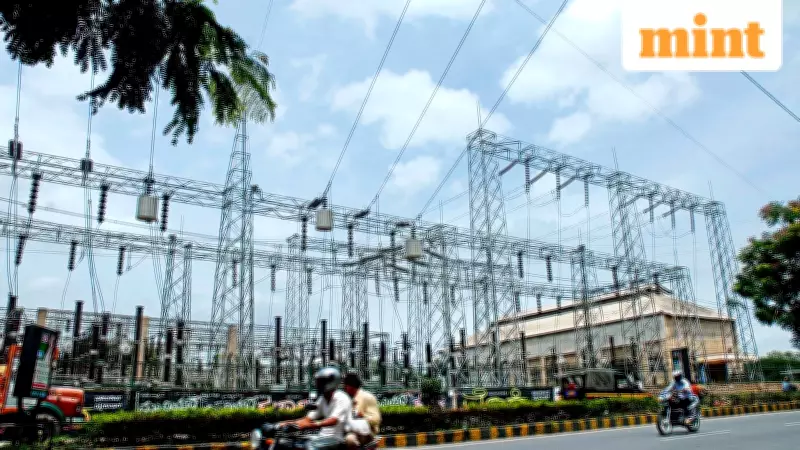
PFC Board Greenlights Merger with Subsidiary REC After Budget Announcement
The board of Power Finance Corporation Ltd (PFC) has formally approved the merger of its subsidiary, REC Ltd, into the parent company. This decisive move comes just days after the Union Budget 2026-27 proposed a restructuring of these two power-sector-focused non-banking financial companies (NBFCs). In a regulatory filing, the PFC board emphasized that it will "ensure that, post-merger, PFC continues to remain as a 'Government Company' under the Companies Act, 2013 and other applicable laws." The detailed merger scheme is set to be finalized and shared publicly after obtaining all necessary approvals.
Government's Rationalization Strategy for Public-Sector NBFCs
In an interview on Thursday, Union Finance Minister Nirmala Sitharaman clarified that both the finance and power ministries will collaborate to outline the specific modalities of this proposed transaction. "What kind of a rationalization it will be, will have to be seen," Sitharaman stated. During her Budget 2026 presentation, she had announced that restructuring PFC and REC is the initial step toward improving the efficiency of public-sector NBFCs. She articulated a vision for NBFCs in 'Viksit Bharat,' with clear targets for credit disbursement and technology adoption, aiming to achieve scale and operational effectiveness.
Historical Context and Financial Significance
REC became a subsidiary of PFC in 2019 when the central government sold its 52.63% stake in REC to PFC for approximately ₹14,500 crore. Notably, in 2022, the finance ministry rejected a proposal from the power ministry to grant development finance institution (DFI) status to PFC Ltd. These Maharatna public-sector NBFCs, under the power ministry's control, play a pivotal role in India's energy transition plans. They provide long-term financing and loans essential for the power sector, with a cumulative loan book of ₹11 trillion. Over recent years, both entities have diversified their lending operations into various infrastructure sectors, including:

- Roads and highways
- Aviation infrastructure
- Port infrastructure
Renewable Energy Financing and Portfolio Details
Both PFC and REC have significantly contributed to renewable energy financing. As of 2024-25, PFC's renewable loan portfolio stood at ₹81,031 crore, accounting for 15% of its overall loan book of ₹5.4 trillion. PFC has supported the installation of 60 gigawatts of renewable energy capacity to date. According to its annual report for 2024-25, PFC's gross non-performing assets were at 1.94% of the loan book.
Similarly, REC's renewable energy portfolio was ₹57,994 crore, representing nearly 1% of its nearly ₹5.7 trillion loan book at the end of the last fiscal year. As of March 2025, REC had supported the installation of 52GW of renewable energy capacity.
Expert Analysis and Market Reaction
Industry experts believe this restructuring will streamline operations and improve credit flow within the sector. Sambit Patra, partner at consulting major Bain & Co. in India, commented, "The restructuring of PFC and REC has the potential to materially shape long-term financing capacity, risk appetite, and project execution velocity across the sector."
On the stock market front, shares of PFC on BSE closed at ₹419.20, down 1.01% from its previous close on Friday, while REC Ltd shares fell 2.51% to ₹372.50 per share. At the end of trading hours on Friday, PFC's market capitalization stood at ₹1.38 trillion, compared to REC's ₹98,087 crore.






