

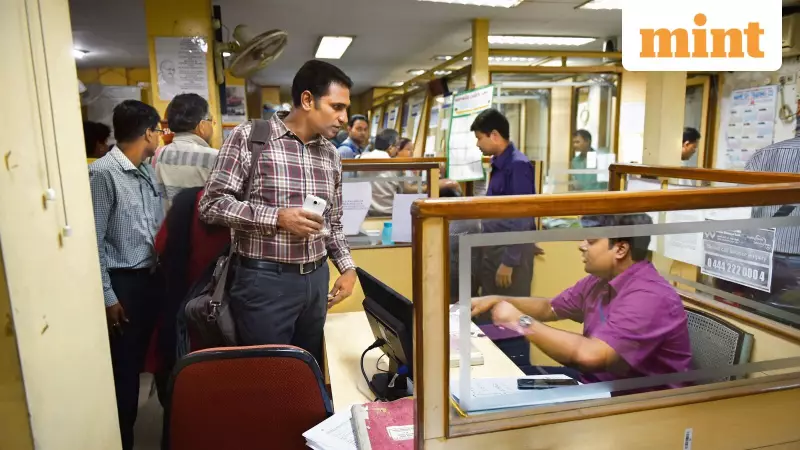
Employees at India's public sector banks are now generating more profit per person than their counterparts in private banks, marking a significant shift in the industry's productivity landscape. Recent data from the Reserve Bank of India highlights this turnaround, driven by strategic changes in hiring, work culture, and government focus.
The Productivity Numbers Tell a New Story
According to data released by the Reserve Bank of India on 29 December, the median profit generated by a public sector bank employee stood at ₹19.6 lakh in the financial year 2024-25 (FY25). This figure notably surpasses the ₹14.5 lakh median profit per employee in private banks. The gap has widened from the previous year, FY24, when public sector bank employees made ₹15.2 lakh each, compared to ₹14 lakh for private bank staff.
Profit per employee is a crucial metric for gauging staff productivity and operational efficiency within banks. For years, public sector banks were perceived as less efficient, often requiring annual capital infusions from the government. The recent data signals a potential end to that era.

Why Are PSU Banks Becoming More Productive?
Industry experts point to a confluence of three major factors driving this change.
First, a sustained trend of limited hiring against a high rate of retirements has reshaped the workforce. Ashvin Parekh, Managing Partner at Ashvin Parekh Advisory Services LLP, explains, "The rate at which employees of PSU banks have been getting superannuated is higher than how fast they are being replaced." This has led to a leaner workforce. The headcount at state-owned banks fell for six years straight before a marginal increase in FY25 to 757,641. In contrast, private banks, though employing more people overall at 838,150, saw their numbers decline too.
Second, there has been a conscious push from the government, as the largest shareholder, to improve business-per-employee metrics. This has translated into a stronger focus on performance and sales culture.
Third, a strategic infusion of private sector talent and modern HR practices is paying dividends. Upasana Agarwal, Partner at ABC Consultants, notes that over the last 3-4 years, PSU banks have emphasized revenue generation, hiring senior executives on contract from private banks to drive transformation in technology, customer experience, and retention.
Cultural Shifts and Lateral Hiring
The change is not just in numbers but also in workplace culture. Veinu Nehru, Managing Partner at Fynehand Consultants, observes a clear shift towards performance-based appraisals in PSU banks, moving away from past practices where employee motivation was often lacking.
A key strategy has been lateral hiring—bringing in experts from other organizations for specific roles. Notable examples include State Bank of India hiring Nitin Chugh, former CEO of Ujjivan Small Finance Bank, as deputy managing director for digital payments, and Bank of Baroda appointing Ian De Souza, formerly of Yes Bank, as CFO. This influx of talent from the private and non-PSU space has acted as a catalyst for cultural change.
Furthermore, banks are strengthening their human resource strategies. For instance, SBI has decided to engage a management consultant to develop a comprehensive 5- and 10-year HR strategy aimed at aligning policies with performance goals and industry best practices.
The merger of 10 public sector banks into four in 2019, aimed at creating stronger lenders, also laid the groundwork for this efficiency drive. As a large cohort of employees is set to retire in the next four to five years, experts like Parekh believe this trend of rising per-employee productivity is likely to strengthen further, redefining the public banking sector in India.






