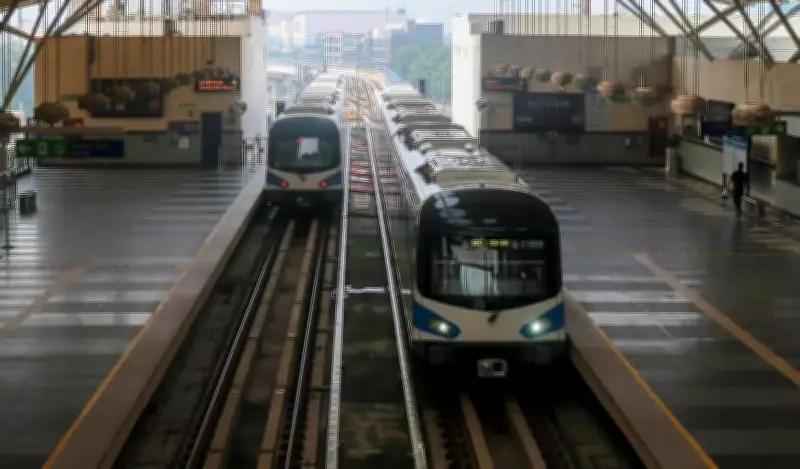
Following a major grid failure on Friday that disrupted Rapid Metro operations, the Haryana Mass Rapid Transport Corporation (HMRTC) is working to secure an alternative power source to prevent future shutdowns. Unlike the Delhi Metro Yellow Line, which remains unaffected during such failures due to its dual-source power supply—one from Delhi and another from the Sector 56 substation in Gurgaon—Rapid Metro currently relies solely on the Sector 56 substation, making it vulnerable during grid instability.
New Power Mechanism Under Development
HMRTC is now exploring options to add a secondary feed to ensure uninterrupted service. The Rapid Metro corridor is set to receive a dedicated alternate electrical supply system. “The move aims to ensure that metro operations never halt again due to grid failures,” an official said. The agency has begun developing a parallel power mechanism that will allow seamless switching between feeders. Once the new system becomes operational, any fault in one power line will automatically push the metro network to the second source, keeping services running without interruption.
Impact of Recent Outage
Metro services were severely affected during the outage when a technical snag at the Sector 72 electricity station crippled the primary power supply. With passengers stranded and operations stalled, the incident highlighted the urgent need for a reliable contingency system. According to officials, the alternate supply network is expected to be ready in four months, significantly strengthening backup supply for Rapid Metro. “The upgraded setup will also integrate safety protocols and modern switching technologies to minimise downtime,” the official added.

Expedited Execution
HMRTC initially submitted the proposal last year, but it gained momentum only after the recent blackout. Officials said that once both feeders are functional, electricity can be sourced from either line, ensuring steady traction power for trains even during peak failures. HMRTC Managing Director Chander Shekhar Khare said that the alternate supply system has been approved, and the agency is fast-tracking its execution. “The enhanced arrangement will secure continuous metro operations and reassure commuters who depend on the service daily,” Khare said.
Details of the Grid Failure
On Friday, a major technical fault triggered by extreme heat and thermal stress led to a fire and explosion at the 220 kV substation of Haryana Vidyut Prasaran Nigam (HVPN) in Sector 72. An oil leakage from a current transformer (CT) caused a fire, resulting in an explosion even before the breaker could trip. The blast damaged the CT, nearby poles, and associated equipment, crippling the system and impacting power supply to two 220kV and five 66kV substations across the city. As a result, supply to 220kV substations in sectors 52 and 56, and 66kV stations at sectors 15, 38, 44, 46, and the Maruti area, remained disrupted.