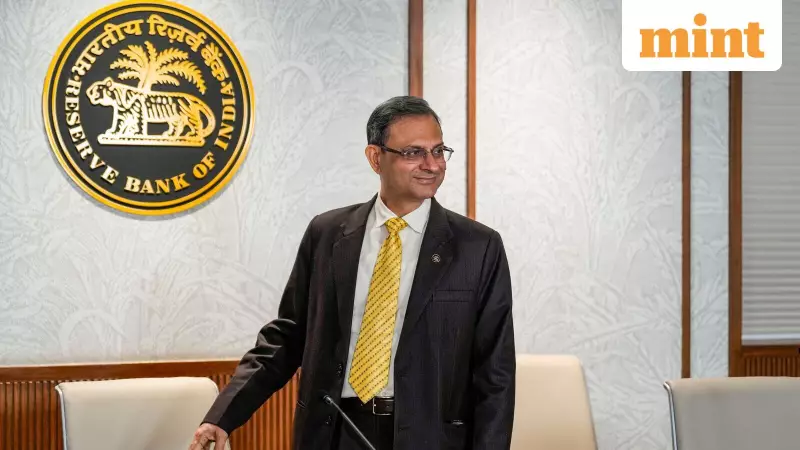
Reserve Bank of India (RBI) Governor Sanjay Malhotra has expressed the central bank's comfort with the current pace of credit expansion, which is roughly in line with the country's economic growth. He indicated that the RBI does not favour credit growth running ahead of fundamental economic strength.
Why RBI Prefers 1x Credit-to-GDP Growth
Speaking at the post-policy conference on Friday, Governor Malhotra highlighted that over the last decade, credit growth has been more or less at a 1:1 ratio with GDP growth, a trend that has served the economy well. "Last 10 years, it's (credit growth) been more or less 1x (the GDP growth) and we have done well," he stated, noting the real GDP growth rate is about 7%.
He cautioned against aspiring for a 2x credit-to-GDP growth, a phenomenon seen before 2011-12. "Earlier, we used to have very high credit growth rates and you did see what impact it had on bank asset quality. So, I don't think 2x is the kind of number that we are looking at," Malhotra explained. He emphasised that the growth rate is dependent on the economy's structure and that the Monetary Policy Committee (MPC) cannot arbitrarily accelerate or decelerate economic or credit growth.

Current Growth Figures and Market Outlook
The RBI has projected real GDP growth for FY26 at 7.3%, with Q3 estimated at 7.0% and Q4 at 6.5%. Growth for Q1 FY27 is seen at 6.7%. This follows India's real GDP growth hitting a six-quarter high of 8.2% in Q2 of FY26.
On the credit side, data for the fortnight ended 14 November 2025 shows bank credit grew 11.3% year-on-year to ₹198 trillion. Non-food bank credit grew 12.0% in FY25, slower than 16.3% in FY24, while GDP grew at 6.5% in FY25.
Market participants believe the recent 25 basis points repo rate cut to 5.25% and liquidity measures worth around ₹1.45 trillion will support credit growth. Executives from Capital Small Finance Bank, Capri Global, and Manappuram Finance noted that lower borrowing costs will stimulate demand in MSME, retail, housing, and auto loan segments.
Rate Transmission and Asset Quality Assurance
Governor Malhotra asserted that the transmission of past policy rate cuts is on track. He clarified that a slower reduction in the average rate of fresh loans is due to an increasing share of higher-yielding loan categories, not weaker transmission. Excluding the latest cut, the cumulative 125 bps reduction since February 2025 has led to a 69 bps decline in the weighted average lending rate (WALR) for fresh rupee loans.
On asset quality, Deputy Governor Swaminathan J. expressed confidence, noting steady trends and controlled growth in unsecured loans. He pointed out that unsecured loans now constitute less than 25% of the overall retail book and 7-8% of total banking credit. "The growth has been seen more in secured segments... and unsecured loans have significantly moderated. So, there are no indicators at this point in time which are creating a concern for us," Swaminathan said, adding that the situation does not warrant new regulatory intervention.
The RBI's stance remains focused on sustainable, fundamentals-driven growth, with vigilance on financial stability and effective monetary policy transmission.