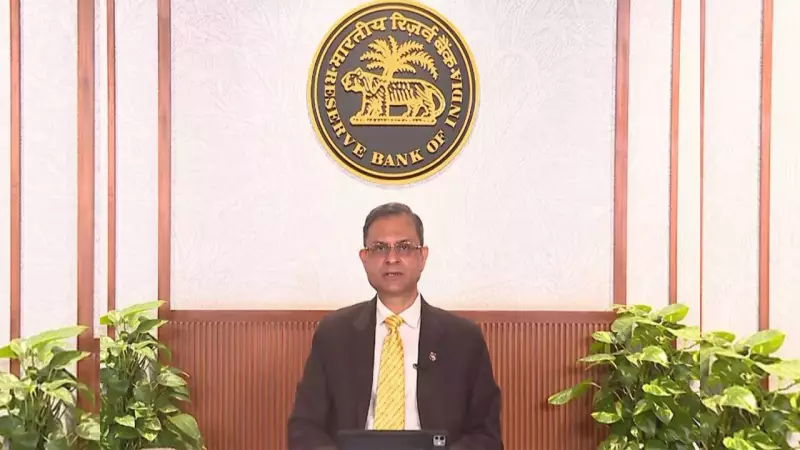
The Reserve Bank of India (RBI) has delivered a significant boost to the economy, announcing a cut in the key policy rate and a substantial upgrade to its growth forecast for the current financial year. In its latest monetary policy review, the central bank's Monetary Policy Committee (MPC) decided to reduce the policy repo rate by 25 basis points, bringing it down to 5.25% from 5.50%.
Rate Cut and Growth Surge
This marks the first reduction in the repo rate since February 2025. The MPC has chosen to maintain a neutral stance even as it acts to support economic momentum. The most striking revision came in the growth projection for the fiscal year 2025-26. The RBI has sharply raised its forecast for real GDP growth to 7.3%, up from the earlier estimate of 6.8%.
Governor Sanjay Malhotra described the current economic phase as a “rare Goldilocks period”, characterized by benign inflation and robust growth. This favourable combination has created the necessary room for the central bank to reinforce the ongoing growth momentum with a rate cut.

Inflation Eases, Liquidity Injected
On the inflation front, the outlook has improved considerably. The RBI has projected the Consumer Price Index (CPI) inflation for 2025-26 at 2%, lower than the previous estimate of 2.6%. This downward revision is primarily attributed to easing food prices. Governor Malhotra noted that underlying inflation pressures are even softer, as about half of the recent rise in the index was driven by precious metals.
To ensure ample liquidity in the financial system, the RBI announced powerful measures to inject nearly Rs 1.45 lakh crore into the bond market. This will be executed through a combination of bond repurchases worth Rs 1 lakh crore and a three-year dollar-rupee swap valued at $5 billion.
Quarterly Projections and Supportive Factors
The central bank also provided a detailed quarterly breakdown of its forecasts, indicating sustained strength:
- GDP Growth: Q3 FY26 is now projected at 7% (vs 6.4% earlier), and Q4 at 6.5% (vs 6.2%). For the next financial year (2026-27), growth is pegged at 6.7%.
- CPI Inflation: Q3 FY26 is forecast at a mere 0.6%, with Q4 at 2.9%. For Q1 of FY27, it is projected at 3.9%.
Governor Malhotra highlighted that GST rationalisation has supported overall demand, while promising monsoon prospects are expected to bolster rural consumption. The economy's resilience is evident from the 8.2% GDP growth recorded in the second quarter, powered by strong services and investment activity.
External Resilience and Global Context
The policy announcement comes against the backdrop of a depreciating rupee, which recently traded around 89.84–90 against the US dollar. Despite foreign institutional investor (FII) outflows and challenges in merchandise exports, Governor Malhotra affirmed the external sector's resilience. This strength is underpinned by robust services exports, steady remittances, and formidable foreign exchange reserves of $686 billion, providing import cover of over 11 months.
Globally, major central banks like the US Federal Reserve and the European Central Bank held their rates steady last month. However, expectations for policy easing in 2026 are building. Domestically, the recent October CPI inflation print of 0.25%—a multi-decade low—provided a supportive backdrop for the RBI's decision.
Bankers have welcomed the move, suggesting the governor seized the window to act despite rupee pressures, as the opportunity for a rate cut may narrow next year when inflation is expected to rise from its current low base. This rate cut is anticipated to improve systemic liquidity and support investment activity in the final quarter of the fiscal year.