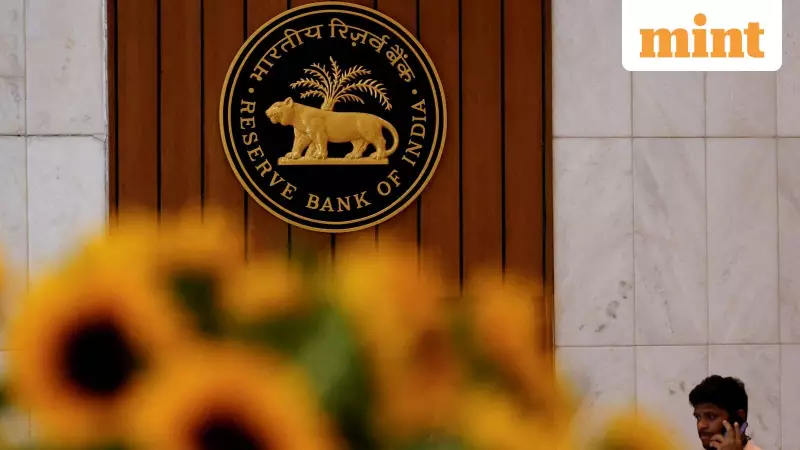
The Reserve Bank of India's Monetary Policy Committee is poised to maintain the current policy rate when it announces its decision on December 5, according to a Mint survey of economists. This comes despite inflation hitting historic lows, creating a complex economic scenario that has divided expert opinion.
Economists Divided on Rate Decision
A detailed poll of 13 economists reveals that nine expect the RBI to pause rates, while four anticipate a 25 basis points reduction to 5.25%. This narrow division underscores the delicate balance the central bank must strike in its upcoming policy announcement.
The disagreement among economists reflects India's unique macroeconomic position, where multiple factors are converging simultaneously. The economy is experiencing record-low inflation, surprisingly robust real GDP growth, weakening nominal GDP expansion, and emerging external sector risks.

Strong GDP Growth Complicates Rate Cut Argument
The Indian economy delivered a stunning performance in the September quarter, posting growth of 8.2% - the highest in six quarters. This figure significantly exceeded the RBI's projection of 7% and the median estimate of 7.2% from a separate Mint survey of 15 economists.
Anubhuti Sahay, Head of India Economic Research at Standard Chartered Bank, emphasized that strong GDP growth combined with already deployed fiscal and monetary stimulus makes a rate pause likely. She noted that the ample liquidity in the system provides more effective monetary policy transmission than an immediate rate cut would achieve.
Aditi Nayar, Chief Economist at ICRA, pointed to the record-low October CPI inflation of 0.25% but stated that the unexpectedly strong Q2 growth above 8% makes a December rate cut improbable. Bank of Baroda's Chief Economist Madan Sabnavis was even more definitive, suggesting that with growth remaining robust and inflation expected to rise toward 4-4.5% next year, the rate cycle has likely concluded.
Inflation and Liquidity Considerations
Retail inflation plunged to an unprecedented low of 0.25% in October, driven by food deflation, GST reductions, and supportive base effects. For FY26, CPI inflation is tracking at 2.0%, well below the RBI's estimate of 2.6%.
Liquidity constraints and banking system stability are central to the argument for maintaining current rates. Mandar Pitale, Head of Financial Markets at SBM Bank India, warned that a policy rate reduction might accelerate the shift of resources away from banks into equities and mutual funds, potentially worsening the credit-deposit imbalance.
With credit-deposit ratios already near historic highs, the RBI appears inclined to preserve liquidity buffers rather than push lending rates lower through formal rate cuts. Economists at ICICI Bank and IDFC First Bank also see limited need for additional easing, citing strong domestic consumption and deposit mobilization constraints.
External Risks and Trade Concerns
A significant factor driving caution is the deterioration in India's goods trade deficit, which widened sharply to a record $41.7 billion in October. This represents the second month following tariff escalation measures.
Pitale of SBM Bank suggested that the RBI might avoid cutting rates to attract interest-rate-sensitive flows and safeguard the balance of payments. Yes Bank added that with consumption becoming the primary growth engine and government capital expenditure likely to moderate, the sustainability of domestic demand remains uncertain.
Meanwhile, nominal GDP growth has been subdued at 8.7%, weighing on tax collections and limiting fiscal support in the second half of FY26.
The Case for Rate Cuts Persists
Despite the strong arguments for maintaining rates, four economists in the survey continue to expect a 25 basis points cut. Nomura has assigned a 65% probability to this scenario, arguing that inflation is likely to undershoot the RBI's medium-term forecasts while the forward growth outlook shows moderation.
Nomura's report from November 28 emphasized that consistency in communication calls for delivering a cut rather than repeatedly promising future action. This perspective gained some support from RBI Governor Sanjay Malhotra's recent comments suggesting scope for further rate reductions.

Deutsche Bank also expects a 25 basis points cut, noting that CPI inflation has fallen below the lower bound of the RBI's 2-6% target range. The US Federal Reserve has continued easing monetary policy, cutting another 50 basis points this year, which maintains comfortable global rate differentials even with an additional RBI cut.
The central bank has maintained rates steady since August, following total cuts of 100 basis points in the first half of this year. With monetary transmission of earlier cuts nearly complete, Deutsche Bank views an incremental 25 basis points reduction as part of the broader easing cycle rather than a standalone adjustment.
The RBI's decision will ultimately reflect its assessment of whether strong growth momentum outweighs the compelling case presented by record-low inflation, with significant implications for India's economic trajectory in the coming months.