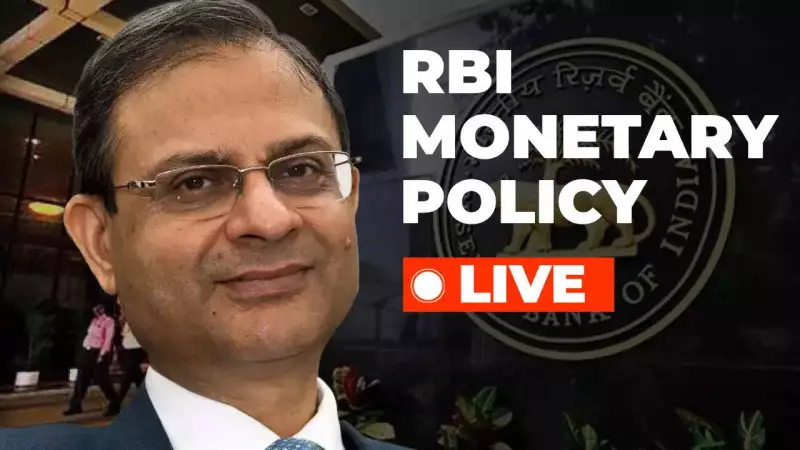
All eyes are on the Reserve Bank of India (RBI) headquarters in Mumbai today as Governor Sanjay Malhotra and the Monetary Policy Committee (MPC) prepare to announce their crucial bi-monthly policy decision. The central question gripping markets and millions of loan borrowers is whether the committee will opt for a reduction in the key repo rate, potentially leading to lower Equated Monthly Installments (EMIs).
The Conflicting Economic Signals
The RBI's decision is set against a backdrop of strikingly divergent macroeconomic data. On one hand, Consumer Price Index (CPI) inflation plummeted to a historic low of 0.25% in October 2025. This figure is not only far below the RBI's mandated target of 4% but also outside the central bank's acceptable tolerance band of 2-6%.
Conversely, the economy is displaying robust growth momentum. Second-quarter real GDP growth for FY 2025-26 surged to 8.2%, significantly surpassing the RBI's own estimates and building on strong performances from the manufacturing and services sectors. This combination of ultra-low inflation and high growth presents a complex puzzle for the rate-setting panel.

Expert Predictions and Market Expectations
Financial markets and economists are largely anticipating a 25 basis points cut in the repo rate, which currently stands at 5.5%. The RBI has already reduced the rate by a full percentage point (100 basis points) since February 2025, responding to a consistent downtrend in inflation.
Mehul Pandya, MD and Group CEO of CareEdge Ratings, highlighted the dilemma, stating that strong GDP growth and multi-year low inflation act as "opposing signals for interest rate decisions." Typically, central banks avoid cutting rates during strong economic cycles but are compelled to act when inflation is persistently low.
However, not all analysts are convinced. A report from the Bank of Baroda expects the RBI to maintain a status quo, keeping the repo rate steady at 5.50% and retaining a neutral policy stance. They argue that sustained economic growth, driven by fiscal discipline and government investment, provides room for caution.
Global Headwinds and Domestic Considerations
The MPC's deliberation is not occurring in a vacuum. The Indian economy faces external challenges, including the impact of 50% tariffs imposed by the United States on Indian exports. Furthermore, the Indian rupee's appreciation, having breached the 90 mark against the US dollar, raises concerns about importing inflation and affecting export competitiveness.
In its previous meeting in October, the MPC unanimously decided to pause, holding the repo rate at 5.5%. The associated Standing Deposit Facility (SDF) rate remained at 5.25%, and the Marginal Standing Facility (MSF) rate stayed at 5.75%.
Governor Sanjay Malhotra's post-announcement commentary will be scrutinized for hints on the future path of monetary policy, assessments of inflation and growth trajectories, and the central bank's view on the rupee's strength. For common citizens, the outcome directly translates to the cost of borrowing—a rate cut could soon mean relief on home, auto, and personal loan EMIs.