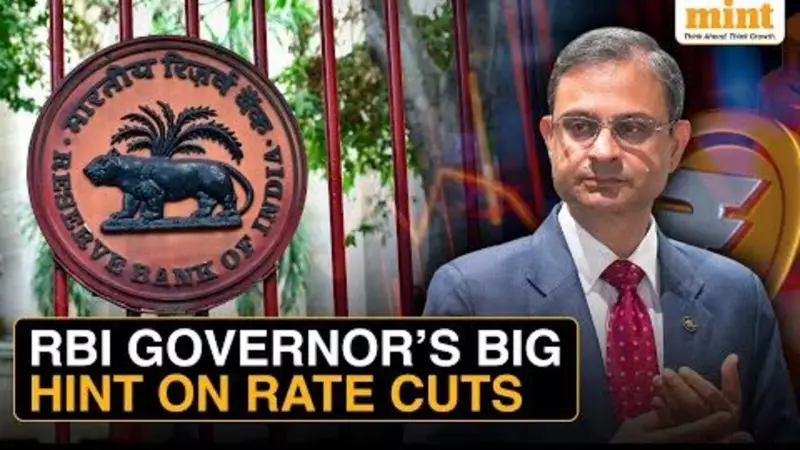
The Reserve Bank of India's (RBI) Monetary Policy Committee (MPC) has begun its crucial three-day meeting, starting December 3 and concluding on December 5. The financial markets are keenly awaiting the policy announcement by RBI Governor Sanjay Malhotra at 10:00 IST on December 5. The committee is set to review key economic indicators including the repo rate, liquidity conditions, inflation trajectory, and growth forecasts.
Global Context and Investor Anticipation
The RBI's deliberations are happening in a unique global environment. Just a week later, on December 9-10, US Federal Reserve Chair Jerome Powell is expected to announce a potential rate cut, with global markets pricing in a 25 basis points reduction. This back-to-back scheduling of major central bank meetings has fueled intense speculation among investors on whether the RBI will mirror the Fed's dovish tilt with a 25 basis points repo rate cut of its own.
Earlier this year, the RBI had reduced the repo rate by a cumulative 100 basis points across three separate actions starting in February, driven by favourable inflation trends. The current economic backdrop presents a mix of robust growth and historically low inflation, with October's print at a decade-low of 0.25%.

Expert Views: To Cut or Not to Cut?
Financial experts are divided on the RBI's likely course of action, presenting contrasting arguments based on domestic and international factors.
Dr. VK Vijayakumar, Chief Investment Strategist at Geojit Investments Ltd, describes the situation as tricky. He notes that the low inflation figure certainly makes a case for a rate cut, a view seemingly supported by the Governor's past comments on having policy space. However, he argues that with the economy growing at a strong 8.2% in Q2 FY26 and operating near full capacity, a monetary stimulus is not necessary. He also highlights the steep depreciation of the Indian Rupee (INR) as a factor demanding status quo on rates.
Echoing the caution, Mohit Gulati, CIO of ITI Growth Opportunities Fund, states a rate cut is not needed immediately. He points to strong growth, anchored core inflation, and suggests that liquidity measures, not policy rate changes, are the more effective tool currently. "India’s economic cycle is structurally ahead of the US, and we should focus on domestic fundamentals—not imported expectations," Gulati added.
On the other side, Abhinav Tiwari, Research Analyst at Bonanza, believes a 25 bps cut is quite likely. He argues it would ease borrowing costs, support credit growth, and improve liquidity. Crucially, he states that an expected Fed cut reduces external risks by easing dollar strength and stabilizing capital flows, giving the RBI room to focus on domestic growth without fearing major rupee volatility.
How a US Fed Rate Cut Impacts Indian Markets
The potential rate reduction by the US Federal Reserve holds significant implications for the Indian economy and stock market. Abhinav Tiwari explains that a Fed cut narrows the interest rate differential between the US and India. This makes Indian assets relatively more attractive, reducing the risk of foreign investors pulling money out of Indian debt markets.
Furthermore, this easing of external pressure provides the RBI with greater flexibility to adjust its own monetary policy without triggering heavy foreign institutional investor (FII) outflows or sharp currency movements. In the medium term, a Fed rate cut generally benefits Indian equities through:
- More affordable global liquidity.
- Increased foreign investment inflows.
- More favourable domestic interest rate conditions.
The final decision of the RBI MPC, set to be unveiled on December 5, will thus be a careful balancing act between supporting domestic growth, managing currency stability, and navigating the evolving global monetary policy landscape.