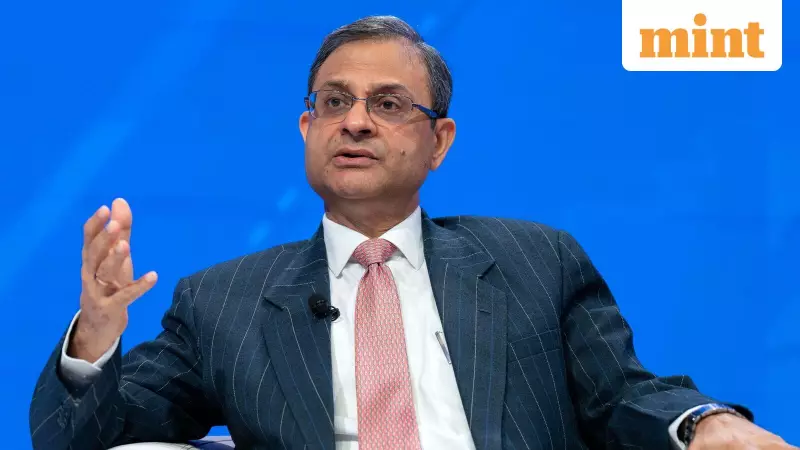
The Reserve Bank of India (RBI) has announced a significant liquidity injection of approximately ₹1.45 trillion into the banking system. Governor Sanjay Malhotra detailed the move on Friday while unveiling the central bank's policy rate decisions, signaling a supportive stance for economic growth.
How the Liquidity Infusion Will Work
The massive infusion will be executed through a two-pronged approach. A substantial portion, ₹1 trillion, will be injected via Open Market Operation (OMO) purchases. In a parallel move, the RBI will conduct a three-year US dollar-rupee swap to infuse another ₹45,000 crore (equivalent to $5 billion).
Under the OMO plan, the central bank will purchase government bonds from commercial banks. This action directly credits banks with rupees, thereby increasing the money supply within the financial system. The forex swap mechanism involves the RBI buying US dollars from banks in exchange for rupees, providing immediate rupee liquidity. The central bank agrees to sell the dollars back after a three-year period.

Context and Market Reaction
This liquidity push comes when the banking system's liquidity surplus stood at ₹2.7 trillion on December 4. Market analysts noted that RBI had previously indicated liquidity at 1% of Net Demand and Time Liabilities (NDTL) is adequate for transmitting past interest rate cuts. However, liquidity has remained below this threshold for several months.
Economists interpreted the combined action of a 25 basis points repo rate cut, a neutral stance, and the liquidity announcement as a dovish and proactive move. "RBI is perhaps once again front-loading its rate cut," remarked Anitha Rangan, Chief Economist at RBL Bank. She added that the OMO move shows the RBI's awareness of government security (G-sec) yields, while the forex swap indicates management of foreign exchange risks, with potential for more support if needed.
Despite the rate cut, the overall policy was perceived as dovish due to growth concerns. "Together, these measures are growth-supportive," said Churchil Bhatt of Kotak Mahindra Life Insurance, adding that the evolving growth-inflation dynamic leaves room for another potential rate cut, supporting bond market sentiment.
Revised Growth and Inflation Forecasts
The Monetary Policy Committee (MPC) revised its economic projections, raising the GDP growth forecast for the current fiscal year to 7.3% from 6.8%. Concurrently, it reduced the Consumer Price Index (CPI) inflation projection for 2025-26 to 2% from 2.6%. Governor Malhotra stated that the benign inflation outlook provides policy space to support growth momentum.
Some experts, like Madhavi Arora of Emkay Global, noted the ₹1.45 trillion infusion is constructive but "modestly below" market expectations of around ₹2 trillion for the remainder of FY26.
A Boost for Non-Banking Financial Companies
The liquidity measures are seen as particularly positive for Non-Banking Financial Companies (NBFCs). Easier financial conditions are expected to soften funding costs for these institutions. Shilpa Bhatter, CFO of UGRO Capital, stated that the announcements will enhance credit flow to small businesses.
This aligns with the RBI's ongoing encouragement for NBFCs to diversify their funding sources beyond traditional bank borrowing. Data shows NBFCs' reliance on bank borrowing has slightly decreased from 43.1% in March 2023 to 42.7% by March 2024.