

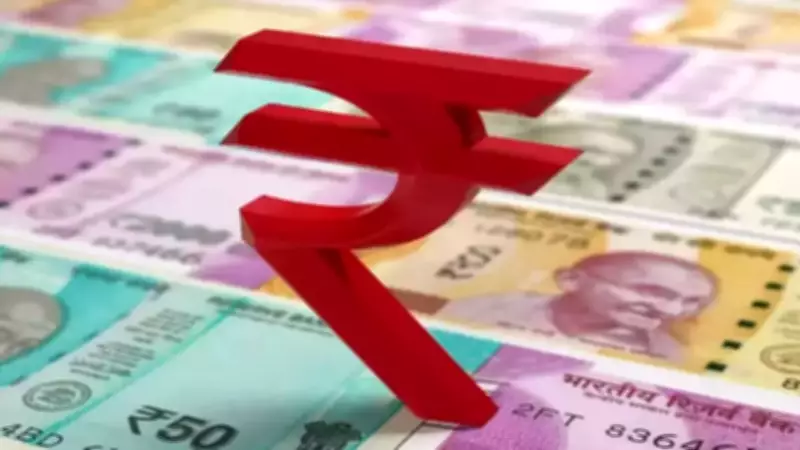
Indian Rupee Continues Downward Slide, Hits 93.96 Against US Dollar
The Indian rupee extended its losing streak on Wednesday, declining by 20 paise in early trading to reach 93.96 against the US dollar. This movement brings the currency perilously close to the psychological 94-per-dollar threshold, reflecting sustained pressure from multiple global and domestic factors.
Persistent Weakness Driven by External Pressures
This latest drop follows a significant 23-paise fall on Tuesday, when the rupee settled at 93.76. The currency's weakness has been consistent throughout the month, with analysts noting it has depreciated by approximately 4.5% during this period. The primary drivers include a robust US dollar performing strongly against major global currencies and elevated international crude oil prices, which typically weigh heavily on India's import-dependent economy.
Foreign portfolio investor (FPI) outflows have emerged as a critical concern, with market participants pointing to uncertainty surrounding the West Asia crisis as a key factor behind the sustained currency weakness. The rupee had already shown vulnerability earlier in the week, briefly approaching the 94-level on Monday before recovering to close flat at 93.53.

Expert Analysis and Market Expectations
Anil Kumar Bhansali, Head of Treasury and Executive Director at Finrex Treasury Advisors LLP, provided insight into the current market dynamics. "Persistent FPI outflows continue to pressure the Indian rupee. A strong US dollar is keeping emerging market currencies weak, and the INR has weakened by about 4.5 per cent during the month," he stated.
Bhansali further projected that "the rupee range for Wednesday is expected to be 93.65 to 94.25," indicating continued volatility in the currency markets.
Stock Markets Defy Currency Weakness with Strong Gains
In a contrasting development, domestic equity markets demonstrated remarkable resilience. Dalal Street witnessed substantial gains, with benchmark indices jumping by over 1% each during early trading hours.
- As of 9:40 am IST, the NSE Nifty50 was trading at 23,212.55, registering an impressive gain of 300.15 points or 1.31%.
- The BSE Sensex mirrored this positive trend, trading in the green with a gain of almost 900 points or 1.22% to reach 74,969.91.
Geopolitical Tensions Add to Market Volatility
Uncertainty surrounding Middle East tensions has triggered noticeable volatility across financial markets. The currency's decline comes amid diplomatic developments, including a 15-point proposal put forward by the United States to Iran aimed at ending the ongoing conflict.
US President Donald Trump indicated that Washington and Tehran are "currently in negotiations" and suggested Iran is eager to strike a peace deal. However, the Islamic Republic has denied holding any direct talks with the United States, adding another layer of complexity to the geopolitical landscape that continues to influence global financial markets.
The combination of currency weakness, foreign fund outflows, and geopolitical uncertainty creates a challenging environment for India's financial markets, even as domestic equities show surprising strength against these headwinds.






