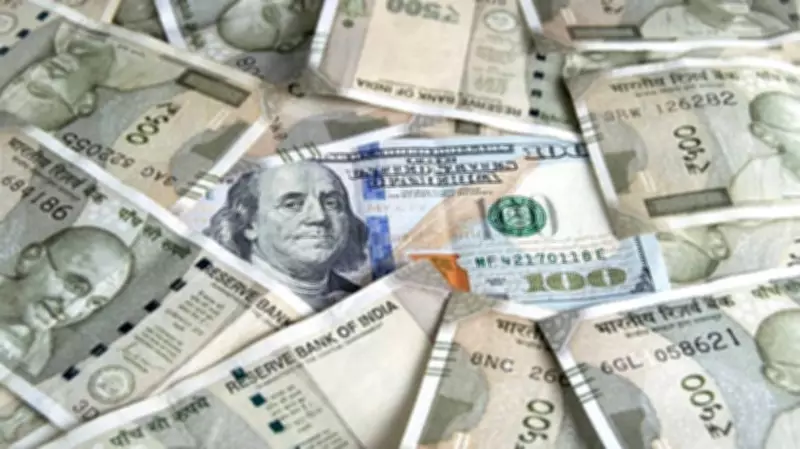
The Indian rupee fell by 28 paise to 94.77 against the US dollar in early trade on Wednesday, pressured by a decline in domestic equity markets and a robust American currency overseas.
Market Overview
At the interbank foreign exchange market, the rupee opened at 94.60 and then slipped further to 94.77, registering a fall of 28 paise over its previous close. On Tuesday, the rupee had settled at 94.49 against the greenback.
Factors Behind the Decline
Forex traders attributed the rupee's weakness to the strength of the US dollar in global markets and sustained selling by foreign institutional investors (FIIs) in domestic equities. Additionally, a negative trend in Asian currencies and a cautious mood ahead of key economic data releases weighed on investor sentiment.

The dollar index, which measures the greenback's strength against a basket of six major currencies, was trading 0.12% higher at 104.50, reflecting sustained demand for the safe-haven asset.
Domestic Equity Impact
Domestic stock markets opened on a weak note, with the BSE Sensex declining over 200 points in early trade, while the broader NSE Nifty slipped below the 22,500 mark. The sell-off in equities further dampened risk appetite and added to the rupee's downward pressure.
Foreign institutional investors were net sellers in the capital market on Tuesday, offloading shares worth Rs 1,234 crore, according to exchange data.
Global Cues
Meanwhile, oil prices remained elevated, with Brent crude hovering near $82 per barrel, raising concerns about India's import bill and trade deficit. Higher crude prices typically put additional strain on the rupee as India is a major importer of oil.
Market participants are now awaiting the release of US inflation data later this week, which could provide further direction on the Federal Reserve's monetary policy stance. A higher-than-expected inflation reading may strengthen the dollar further and keep the rupee under pressure.
Expert Views
Analysts expect the rupee to trade in a range of 94.50 to 95.00 in the near term, with the bias remaining negative amid global headwinds. They advise that any intervention by the Reserve Bank of India (RBI) could provide some support to the currency.
The RBI has been actively managing the rupee's volatility through periodic dollar sales, but the central bank's ability to stem the decline may be limited if the dollar continues to strengthen globally.
On the domestic front, the rupee's weakness is also being fueled by concerns over the widening trade deficit and capital outflows. India's trade deficit widened to $18.7 billion in January, compared to $17.6 billion in the previous month, according to official data.
In summary, the rupee's fall reflects a combination of global and domestic factors, including a strong dollar, weak equities, high oil prices, and persistent FII outflows. The currency is likely to remain under pressure in the coming sessions unless there is a significant reversal in these trends.