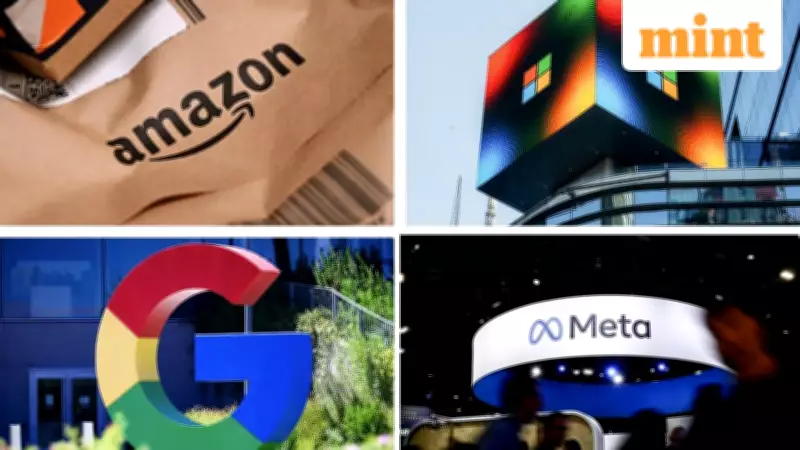
Big Tech's Unprecedented Capital Expenditure Boom
The landscape of global technology is undergoing a seismic shift as major players embark on a historic spending spree. In 2026, Big Tech companies are projected to allocate approximately $650 billion toward capital expenditures, primarily driven by investments in artificial intelligence data centers. This staggering sum rivals the gross domestic product of Argentina, the world's 26th largest economy, highlighting the scale of this financial transformation.
Detailed Breakdown of 2026 Capex Projections
Leading the charge, Amazon has announced guidance for $200 billion in capital expenditures for 2026. Alphabet follows closely with an estimated $180 billion, while Meta Platforms plans to spend around $125 billion. Microsoft, operating on a fiscal year ending in June, reported $72 billion in capex during the first half of 2026. If this pace continues, its annual expenditure will significantly contribute to the collective total. This surge marks a sharp increase from the over $400 billion spent by these four companies in 2025, which was comparable to Pakistan's GDP according to the International Monetary Fund.
Impact on Financial Statements and Margins
The massive capital outlays are set to dramatically alter the financial health of these tech giants. On the income statement, capex is accounted for through depreciation costs spread over several years. For instance, servers and networking equipment in AI data centers are typically depreciated over five to six years. Alphabet estimates that servers alone will constitute 60% of its total spend. With a planned $180 billion investment, approximately $108 billion will be allocated to servers. Depreciated over six years, this translates to $18 billion in annual expenses starting next year, not including non-server capex. Alphabet's depreciation expense, which was $21 billion in 2025, is likely to double by the end of 2026, exerting considerable pressure on gross margins.

Balance Sheet and Debt Accumulation
On the balance sheet, these companies added nearly $117 billion in debt and lease liabilities in 2025. Recent activities include Alphabet raising at least $27.5 billion from the debt market this week. Although still modest, fourth-quarter interest expenses for the group surged by more than 50% compared to the previous year. Projections suggest that new debt and leases for these four companies could approach $200 billion in 2026, with other providers like Oracle potentially borrowing up to $50 billion.
Cash Flow Challenges and Shareholder Returns
The cash flow statement reveals the most abrupt changes. Despite generating over half a trillion dollars in operational cash flow in 2025, capital expenditures reduced free cash flow to $163 billion. Free cash flow, essential for dividends and share buybacks, left only $28 billion after these outlays. To maintain the same free cash flow level as 2025, operational cash flows must grow by about 30%. However, analysts predict an average rise of just 19%, potentially forcing companies to slow or suspend buybacks and delay dividend increases. Some, like Amazon and Meta, might even experience negative free cash flow in 2026.
Revenue Offsets and Strategic Gambles
For Amazon, Microsoft, and Alphabet, the spending is balanced by substantial revenue from cloud units, which rent out AI servers to customers. Analysts forecast cloud revenue to reach about $370 billion in 2026, supported by large multiyear backlogs. Google Cloud, in particular, is seeing expanding operating margins. If cloud revenue continues to grow robustly, the capex investments could be justified. In contrast, Meta faces a higher risk as it lacks cloud unit revenue to offset costs. Spending around $200 billion over two years on AI data centers for internal use, such as research and ad targeting, Meta's strategy represents a significant gamble, reminiscent of its Metaverse pivot.

Apple's Conservative Approach
Notably absent from this capex conversation is Apple. Among Big Tech firms, Apple maintains a hybrid model, relying on third-party servers primarily from Google, and spent just $12 billion on capex in 2025. This conservative strategy left it with $123 billion in free cash flow, most of which was returned to shareholders. While competitors reshape their financials, Apple remains asset-light, affording it time to refine its AI strategy without the immediate financial pressures faced by its peers.