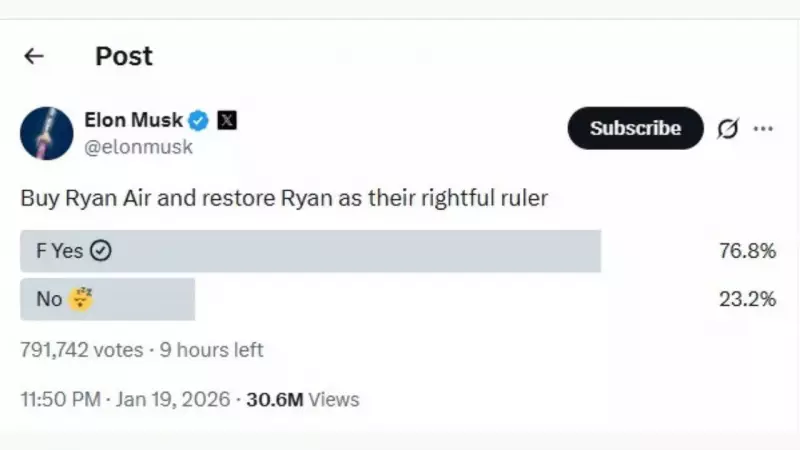
Elon Musk has once again taken to social media to stir up a major conversation. This time, the billionaire entrepreneur turned his attention to Europe's biggest budget airline. Musk posted a public poll on X, asking users whether he should acquire Ryanair. The move followed a heated exchange with the airline's outspoken chief executive, Michael O'Leary.
The Poll That Captured Global Attention
Elon Musk's poll on X posed a straightforward question. He asked if he should buy Ryanair. The options reflected Musk's characteristic informal style. Within hours, the poll attracted massive engagement. It crossed more than 750,000 votes and trended widely across the platform. Musk added playful commentary to the situation. He suggested that Ryanair should be run by someone actually named Ryan. In one post, he wrote about wanting to "restore Ryan as their rightful ruler." These humorous remarks fueled further sharing and kept the topic alive online.
Business Disagreement Turns Personal
The conflict started with a business disagreement over Starlink. Musk's satellite internet service faced rejection from Ryanair for in-flight Wi-Fi. Michael O'Leary explained the airline's position clearly. He told Reuters that the economics simply did not work for Ryanair's operations. The airline focuses on short-haul flights across Europe. Most journeys last under two hours. O'Leary stated that passengers would not pay for Wi-Fi on such brief trips. He also highlighted significant cost barriers.

Installing Starlink-compatible antennas would cost between $200 million and $250 million annually. Additionally, the equipment could increase aircraft drag. This would lead to higher fuel consumption and operating costs. Musk disputed these estimates publicly. However, he did not provide detailed counter figures to support his argument.
Insults Fly on Public Platforms
The professional disagreement quickly turned personal. Michael O'Leary made sharp comments about Musk during a radio interview. He called Musk "an idiot" and described him as "very wealthy, but still an idiot." O'Leary advised listeners to ignore Musk entirely. Musk fired back on X without hesitation. He labeled O'Leary "an utter idiot" and suggested he should be fired. The exchange escalated further when Ryanair's official social media account joined in. During a service outage, they posted a taunting message asking if Musk needed Wi-Fi.
Musk responded with another provocative question. He asked if he should buy Ryanair and put "someone whose actual name is Ryan in charge." Later, he sent a direct message inquiring about the cost of purchasing the airline. This back-and-forth captured widespread media attention and public interest.
Starlink's Practical Challenges for Budget Airlines
At the heart of this dispute lies a technical and economic challenge. Starlink's in-flight internet service works well for some airlines. Several carriers operating long-haul routes have adopted it successfully. Passengers on lengthy flights often show willingness to pay for connectivity. However, Ryanair's business model presents a different scenario. The airline prioritizes low fares and high turnover. Adding premium services could raise costs and disrupt their competitive pricing strategy.
O'Leary has consistently argued that keeping ticket prices affordable remains the top priority. He maintains that features like paid Wi-Fi do not align with Ryanair's core offering. Musk continues to challenge this perspective, though specific counterarguments on cost remain unclear.
Public Engagement Through Social Media
Elon Musk's decision to involve the public directly through a poll amplified the entire episode. The poll remained active for an extended period, with voting continuing until its closure. At the time of writing, approximately 76.8% of respondents voted in favor of Musk buying Ryanair. Musk has not clarified whether the poll represents a genuine acquisition plan or simply serves as a public provocation. Regardless, the scale of engagement ensured sustained attention across news platforms and social media channels.

This corporate spat highlights how modern business disagreements can unfold in real-time on public platforms. It also demonstrates the power of social media to transform professional debates into viral spectacles. The combination of high-profile personalities, sharp exchanges, and direct public participation created a perfect storm of online discussion.