

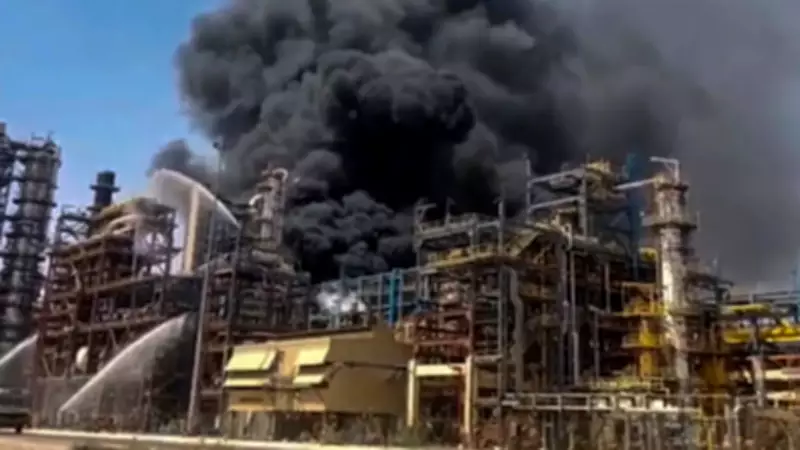
Major Fire at Rajasthan's Pachpadra Refinery Sparks High-Level Investigation
A day after a significant fire erupted at Rajasthan's Pachpadra refinery, a comprehensive investigation has been launched involving multiple security and forensic agencies. The blaze occurred just before Prime Minister Narendra Modi was scheduled to inaugurate the facility on Tuesday, adding urgency to the probe.
High-Level Teams Converge on Refinery Site
Officials from various security agencies, including the National Investigation Agency (NIA), forensic teams, and the state administration led by Chief Minister Bhajan Lal Sharma, reached the site in Balotra to assess the extensive damage. Sharma, accompanied by several ministers and officials, conducted a thorough inspection alongside a team from the Rajasthan Anti-Terrorism Squad (ATS).
The inspection included detailed discussions with refinery management to understand the sequence of events and immediate response measures. The presence of multiple security agencies underscores the seriousness with which authorities are treating the incident, particularly given its timing relative to the planned inauguration.

Four-Member Probe Team Established
A dedicated four-member investigation team has been constituted to examine all aspects of the fire. Among their primary tasks will be determining why the refinery's fire extinguishing system failed to operate as intended. Officials familiar with the situation confirmed that this first line of defense did not deploy immediately when the fire broke out, raising significant safety concerns.
The probe team will work to identify the exact cause of the incident while evaluating the effectiveness of existing safety protocols. Their findings will be crucial for preventing similar occurrences at this and other industrial facilities across the country.
Ministry and Company Responses
Sujata Sharma, Joint Secretary in the Petroleum Ministry, announced that the investigation team is led by former MRPL Managing Director M Venkatesh, who has already reached Barmer to begin work. "We will only be able to tell you the reasons and how much time the repair will take after the report is submitted," she stated, emphasizing the need for thorough analysis before drawing conclusions.
Hindustan Petroleum Corporation Limited (HPCL), which holds a 74% stake in the refinery with the Rajasthan state government owning the remaining 26%, issued a preliminary assessment. "Prima facie it appears that leakage of hydrocarbons through the valves or flanges in the heat exchanger circuit caused the fire," the company stated.
HPCL confirmed that the fire was contained within the heat exchanger stacks in the crude distillation unit section of the refinery. While the financial and operational impact is still being assessed, the company indicated that preliminary evaluation suggests the damage is not expected to be material in scale.
Safety Systems Under Scrutiny
The failure of the fire extinguishing system has emerged as a critical focus of the investigation. Officials have highlighted that this system represents the primary protective mechanism against such incidents, and its malfunction raises serious questions about maintenance protocols and emergency preparedness.
As the investigation progresses, authorities are expected to examine:
- The specific technical failure that prevented the extinguishing system from activating
- Regular maintenance and testing procedures for safety equipment
- Personnel training and emergency response protocols
- Structural integrity of refinery components
The timing of the fire, occurring just before the Prime Minister's scheduled visit, has added political significance to what might otherwise have been treated as an industrial accident. The involvement of multiple security agencies suggests authorities are considering all possible angles, including potential sabotage, though no such indications have been officially confirmed.
As repair assessments begin, the refinery's operations remain suspended pending completion of the investigation and implementation of any recommended safety improvements. The incident serves as a stark reminder of the constant vigilance required at major industrial facilities handling hazardous materials.






