

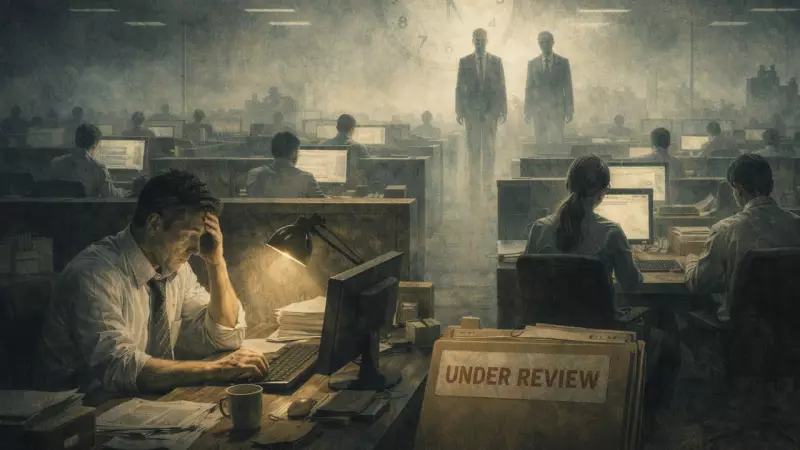
Remember Thomas Gradgrind's famous demand for "Facts" in Charles Dickens' Hard Times? It wasn't a plea for truth, but a warning. In the industrial town of Coketown, facts were tools to discipline human life, not illuminate it. Workers became mere numbers, their value measured only by output, their security an afterthought. They were employed, yet never settled. Fast forward to today, and the core condition remains, albeit with a modern vocabulary. The contemporary workplace has perfected a method to maintain productivity while systematically eroding employee assurance.
The Anatomy of the 'Forever Layoff'
Glassdoor's Worklife Trends 2026 report has put a name to this modern malaise: the 'forever layoff'. This pattern describes an environment where layoffs are not one-off events but an ongoing process. Job cuts arrive in relentless, smaller waves rather than a single, dramatic tsunami. The data is stark and would satisfy even Gradgrind's obsession with figures. In 2025, layoffs affecting fewer than 50 employees constituted 51 per cent of all layoffs. This is a significant rise from just 38 per cent in 2015. The traumatic event of job loss has been broken down into endless, manageable increments, with the ending perpetually postponed.
This shift replaces the spectacle of mass dismissal with something far more subtle and corrosive. The psychology is no longer about panic but permanence. The initial shock of layoffs fades, but a low-grade, chronic uncertainty takes root. Employees find themselves in a liminal state—neither dismissed nor secure. They remain inside the corporate system, perpetually alert to silence and sensitive to the slightest signals, performing a sense of continuity in conditions that fundamentally offer none. Psychologists identify this as chronic uncertainty, a stressor that heightens vigilance while steadily dissolving trust.

Kafka's Trial in the Modern Office
This phenomenon finds an eerie parallel in Franz Kafka's novel, The Trial. The protagonist, Josef K., is arrested one morning in a calm, almost bureaucratic manner. He is not taken away; his daily life continues. He is simply informed that a trial is pending against him. The authority doesn't drag him out; it settles into his mind. His freedom remains, but his certainty vanishes. Every interaction becomes loaded with meaning, every delay a potential sign.
The forever layoff creates an identical condition. Employees are not expelled; they are left inside, performing, complying, and waiting. Like Josef K., they are not told the full charges or when a resolution will come. A mass layoff ends the story for those let go. The forever layoff suspends the narrative indefinitely for those who stay. Kafka understood what management science is now leveraging: Uncertainty is a more efficient tool for control than outright force. A trial without a verdict disciplines more thoroughly than a sentence ever could.
The Slow Poison: Impact on Work and Well-being
The forever layoff is not a firing squad; it's a constant, demoralizing drizzle. Its impact is profound and multi-layered:
1. The Contraction of Time and Ambition: In a stable workplace, careers are envisioned in arcs spanning years. Under the shadow of serial, small-scale cuts, the future shrinks. Employees start planning in weeks or months, not years. Ambition turns tactical, learning becomes selectively useful, and long-term bets are seen as naivety.
2. Performative Productivity: Productivity might not fall; it can even spike as fear acts as an accelerant. However, this fuel is impure. It drives people toward work that is easily measured and visible—dashboard metrics thrive—over deep, creative, or innovative work that requires trust and carries risk of public failure. Organizations get motion, not necessarily meaningful progress.
3. The Erosion of Trust and Culture: When layoffs come in small batches with vague explanations, workplace culture fills the void with speculation and rumor. Trust thins because the official narrative is always incomplete. Colleagues become cautious, mentorship weakens, and a climate of self-protection takes hold.

4. The Politics of Proximity: Power subtly shifts to those closest to decision-making, those with even vague foresight about what's coming next. Ambiguity becomes a form of leverage. Employees adapt by managing perceptions—striving to be visible but not controversial, useful but not expensive.
The ultimate existential impact is that the workplace transforms into a waiting room with no clock and no scheduled announcement. The institution functions, but it ceases to offer belonging. People are employed, yet feel provisionally placed. The verdict is always pending.
Careers on the Edge of Certainty
Dickens warned of a world that worships facts and forgets people. Kafka showed how power thrives on postponement rather than punishment. Today's workplace is a fusion of both visions. Careers are relentlessly measured and judged, yet rarely conclusively settled.
For the modern professional, this demands a brutal recalibration. The promise is no longer stability, but mere survivability; not belonging, but transient relevance. Staying employable means staying alert, adaptable, and quietly replaceable. While this model may keep institutions operationally efficient, it leaves the individual profoundly unmoored.
The greatest risk is not that work becomes harder, but that this pervasive insecurity becomes normalized—internalized as the inevitable price of ambition. A career built entirely inside this permanent trial mode may endure, but it will likely be thinner, more cautious, and shorter on genuine fulfillment than what was once imagined.





