

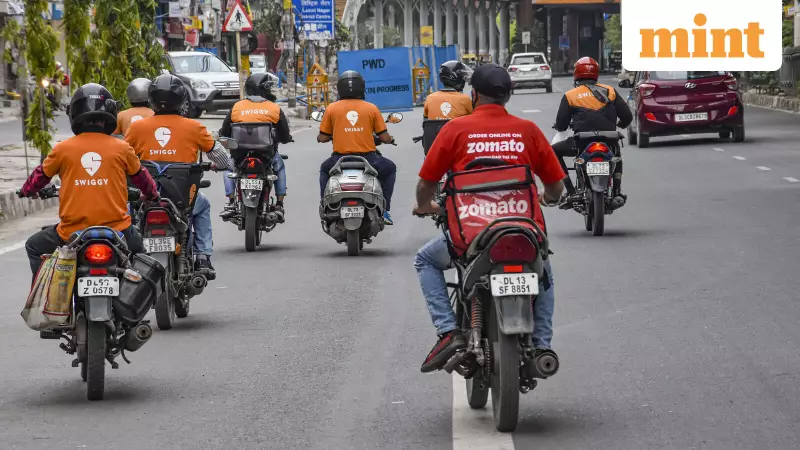
A nationwide strike called by gig workers against major food delivery platforms Swiggy and Zomato on New Year's Eve proved largely ineffective, as financial incentives offered by the companies led most delivery partners to prioritize earnings over protest.
Platforms Counter Strike with Lucrative Offers
In anticipation of the planned industrial action, both Swiggy and Zomato rolled out attractive financial packages for riders working on December 31. Zomato set peak-hour delivery rates between ₹120 and ₹150 per order from early evening until midnight, according to an internal communication reviewed by Mint. The company also temporarily waived penalties for refusing or cancelling orders, enabling riders to potentially earn around ₹3,000 for the day.
Swiggy, on the other hand, structured a year-end incentive that allowed delivery executives to earn up to ₹10,000 across December 31 and January 1. Its communication to partners highlighted peak-hour earnings potentially reaching ₹2,000 during the busy evening period.

Strike Fails Amidst Worker Dissent and Lack of Unity
Despite expectations that nearly 150,000 delivery workers would join the protest, the actual participation was minimal. Many riders chose to work, unwilling to forgo the rare opportunity for higher income. Base pay for deliveries has shrunk dramatically, falling from around ₹60 per order earlier this year to nearly ₹15 currently, making festive incentives a crucial income source rather than a mere bonus.
"There is no unity among us to stand up for a cause," said a Bengaluru-based delivery worker, speaking anonymously. "Even if a couple of us want to go on a strike, there are others who’d still work today and earn more. Why should we miss out?"
Zomato's CEO, Deepinder Goyal, confirmed the strike's limited impact in a social media post on January 1. He stated that Zomato and Blinkit delivered a record 7.5 million orders to over 6.3 million customers on New Year's Eve, facilitated by more than 450,000 delivery partners. He credited support from law enforcement for managing "a small number of miscreants" and emphasized that the day proceeded with incentives consistent with previous New Year's Eves.
Underlying Grievances and Elusive Gains Remain
While the strike itself failed, the core issues raised by gig workers remain unresolved. Earnings dashboards viewed by Mint revealed that the promised incentives often translated into long hours for limited gains. One partner earned ₹844 after being logged in for nearly 13 hours and completing 22 trips, while another made ₹591 after over 10 hours and 16 deliveries.
"Why can’t they raise our payouts? Why is this only for one day?" questioned the anonymous delivery worker, highlighting the daily struggle with rising costs like e-bike maintenance and fuel against shrinking wages.
Union leaders criticized the platforms' tactics. Shaik Salauddin of the Telangana Gig and Platform Workers’ Union called the year-end incentives a "distraction from systemic issues." He outlined key demands: restoration of fair pay, an end to unsafe 10-minute delivery models, protection from arbitrary penalties, and comprehensive social security including health insurance and pension.
In a letter to the Union Labour Minister on December 30, the Indian Federation of App-Based Transport Workers (IFAT) warned of the human cost of platform competition, accusing companies of using "intimidation, ID deactivations, and algorithmic punishment" to weaken collective action. They urged government intervention to ensure fair wages and workers' rights.
The protest also highlighted gender inequalities within the gig economy. Nirmal Gorana of the Gig and Platform Service Workers’ Union pointed out that women workers face lower payouts, lack menstrual leave, and live under the constant threat of ID deactivation, making the work "deeply exploitative."
Despite the setback, the event underscores the growing tension within India's gig economy, where workers balance the need for immediate income against the long-term fight for better working conditions and sustainable wages.






