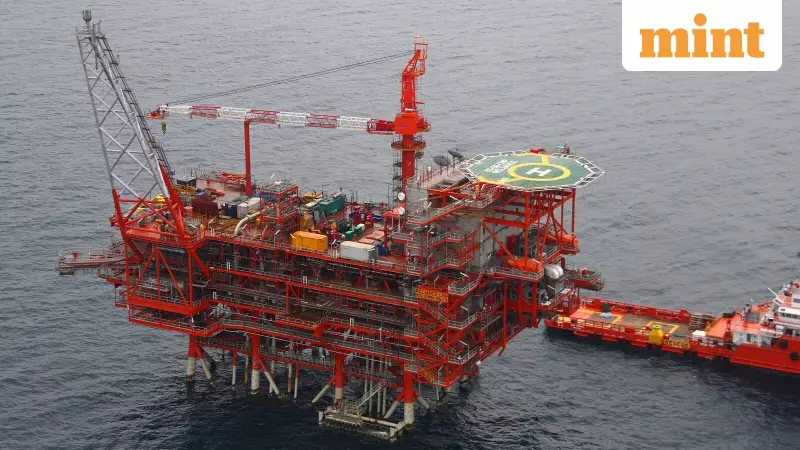
In a landmark legal battle, the Indian government is seeking compensation exceeding $30 billion from corporate giants Reliance Industries and its partner BP. The claim, the largest ever pursued by the state against a corporation, centers on allegations that the companies failed to produce vast quantities of natural gas from key offshore fields.
The Core of the KG-D6 Dispute
The arbitration case, which has been ongoing since 2016, revolves around the D1 and D3 deepwater gas fields located in the Krishna Godavari (KG) basin's D6 block. Awarded to Reliance in 2000 under a production sharing contract, these fields were hailed as India's first major deepwater gas project and a cornerstone for energy security. However, the project was marred by technical challenges like water ingress and reservoir pressure issues, leading to production falling far short of initial estimates.
The government's position, as presented in the confidential arbitration, is stark. It alleges that Reliance initially estimated recoverable reserves at 10.3 trillion cubic feet (tcf), later revising it down to 3.1 tcf. Authorities argue that due to mismanagement by the consortium, most of these reserves were lost, resulting in a massive financial loss for the nation, which owns the resource.

Allegations of Mismanagement and Aggressive Extraction
Sources familiar with the proceedings state that the government has accused Reliance of employing "unduly aggressive" production methods. A key allegation is that the company drilled and used only 18 wells instead of the 31 initially planned, and did so without adequate supporting infrastructure. This approach, the government contends, damaged the reservoir and led to the irreversible loss of gas.
The final arguments in this high-stakes arbitration were heard on November 7. A three-member tribunal is now deliberating and is expected to deliver its verdict by mid-2026. Any ruling can subsequently be challenged in Indian courts, potentially prolonging the resolution of this decade-long dispute.
Financial Stakes and Contractual Complexities
The staggering $30 billion claim is calculated as the value of the gas that was not produced. The government asserts that only about 20% of the estimated 10 tcf was ever extracted from the D1 and D3 fields. Reliance and BP have reportedly disputed any liability, arguing they owe nothing to the government.
The backdrop of this conflict includes the production sharing contract model, where operators like Reliance are allowed to recover their costs from sales before sharing profits with the government. This block has also seen previous cost-recovery disputes. In a significant deal, BP bought a 30% stake in the KG-D6 block and other assets from Reliance for $7.2 billion in 2011.
Reliance announced the cessation of production from the D1 and D3 fields in February 2020, stating that overall production from the broader KG-D6 block had reached 3 tcf of gas equivalent. Both Reliance and BP have declined to comment on the ongoing arbitration, citing confidentiality. Several key government ministries have also not responded to requests for comment, keeping the details of the case largely behind closed doors until the tribunal's decision.