

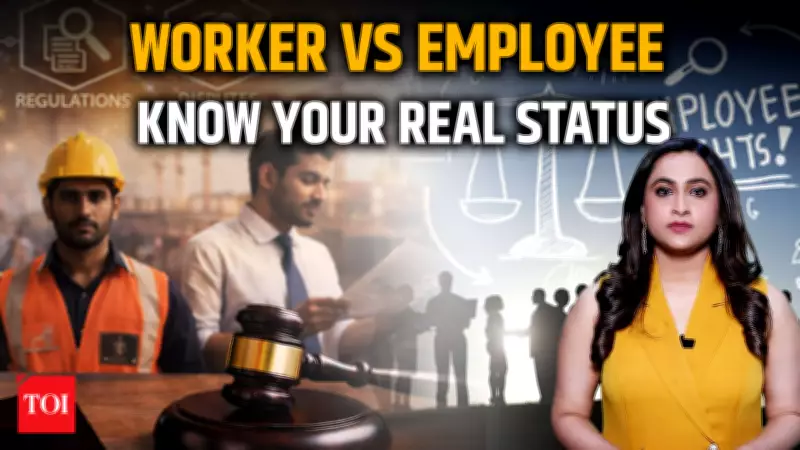
India's Labour Codes: Decoding the Critical 'Worker' vs 'Employee' Distinction
Are you legally classified as a "worker" under India's newly implemented labour codes, or are you merely an employee? This seemingly subtle distinction carries profound implications for your workplace rights, benefits, overtime compensation, and overall job security. The answer hinges not on your official job title but on the nature and conditions of your actual work.
Why Your Job Title Doesn't Define Your Legal Status
The new labour codes, which consolidate and modernize India's complex labour laws, establish clear legal definitions that override informal designations. An "employee" is a broad category, while a "worker" refers specifically to individuals engaged in manual, unskilled, skilled, technical, operational, or clerical work. Crucially, this includes those working for wages in establishments like factories, mines, plantations, and other specified sectors, regardless of their contractual title.
Your daily tasks, work environment, and remuneration structure are the definitive factors. For instance, a person in an office might be called an "executive" but could legally qualify as a "worker" if their duties are primarily clerical or operational.

Key Rights and Benefits Impacted by This Classification
The classification directly governs entitlement to several critical provisions:
- Overtime Pay: Workers are entitled to overtime wages at prescribed rates for work beyond standard hours, a protection that may not uniformly apply to all employees.
- Leave Encashment: Rules regarding the encashment of earned leave can differ significantly based on whether one is a worker or a non-worker employee.
- Retrenchment Benefits: The process and compensation required in case of job termination are more stringently regulated for workers.
- Grievance Redressal: Workers have access to specific statutory grievance mechanisms and dispute resolution forums.
- Social Security: Contributions and benefits under schemes like Provident Fund and Employees' State Insurance are often mandated for workers.
Who Needs to Pay Attention?
This is essential knowledge for anyone employed across India's diverse economic landscape. Whether you work in corporate offices, manufacturing factories, IT services, retail, hospitality, or the gig economy, understanding your correct classification is paramount. Misclassification by employers can lead to denial of lawful benefits and protections.
The labour codes aim to simplify compliance but place the onus on both employers and individuals to correctly interpret these definitions. As the codes are implemented, legal clarity on borderline cases will evolve through judicial interpretation and government notifications.
Ultimately, knowing if you are a "worker" empowers you to claim your full legal entitlements, ensuring fair treatment and security in India's evolving job market.






