India's Private Equity Playbook Undergoes Major Transformation
MUMBAI: The private equity (PE) investment strategy in India is undergoing a significant evolution, marking a departure from traditional approaches. Historically, PE investors in India predominantly took minority stakes, allowing founders to retain control and manage operations. However, a notable shift is underway, with investors increasingly acquiring majority or controlling stakes, thereby taking a more direct role in shaping the future of companies.
Buyouts Gain Momentum in Deal Landscape
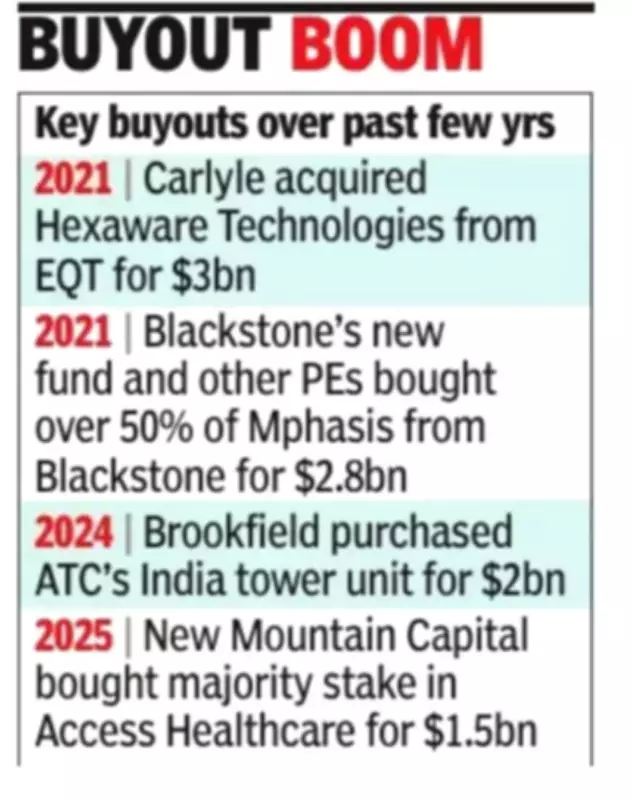
While minority investments continue to dominate in terms of overall deal value, buyout transactions are rapidly gaining ground. According to data from EY-IVCA, between 2021 and 2025, buyouts accounted for 24% of India's total private equity investments, amounting to $71 billion out of $303 billion. This positions buyouts as the third-largest investment category, trailing only growth and startup investments.
In a recent example highlighting this trend, US-based Carlyle agreed to acquire a majority stake in Edelweiss's home finance business for $230 million. This transaction adds to a growing list of buyouts that are reshaping India's deal landscape, particularly in key sectors such as financial services, technology, and healthcare.

Foreign Firms Lead the Charge
These control transactions are largely spearheaded by foreign private equity firms, including prominent names like Blackstone, Brookfield, Carlyle, Advent, EQT, and KKR. Their involvement underscores the increasing attractiveness of the Indian market for strategic, long-term investments.
Changing Attitudes Among Founders and Families
Unlike in the past, when founders and business families were often reluctant to sell controlling stakes to PE investors, there has been a "sea change" in attitude. Vivek Soni, partner in PE services at EY, noted that PE is now viewed as a reliable partner. He explained, "Succession issues, exits from non-core businesses, buying out other family members or earlier PE investors, and managing volatility risks are key triggers for control trades."
Puncham Mukim, India head of private equity at Everstone Capital, added, "Historically, India has seen minority stakes and growth capital play out, but the attractive returns and exit certainty of buyout investments eventually took centre stage." From a founder's perspective, the new generation has shown greater openness to control transactions, often undertaking large secondary sales to establish family offices.
Sponsors Evolving into Strategic Investors
Mukim further emphasized that sponsors are increasingly acting like strategic investors, focusing on building platforms rather than making passive investments. Their ability to attract seasoned professional managers and strengthen corporate governance has enabled them to effectively run and scale businesses that were previously family-managed.
Soni highlighted that PE firms are doubling down on pure-play buyouts due to "good" exit returns. EY-IVCA data supports this, showing that between 2021 and 2025, PE investors realized $48 billion through exits. Secondary sales constituted the largest share of these exits, followed by strategic exits and stock market listings.
Market Dynamics and Challenges
While buoyant capital markets provide PE investors with an attractive exit route through initial public offerings (IPOs) at strong valuations, they also present competition in striking control trades. Elevated equity markets tend to raise seller expectations, widening the bid-ask gap between founders and PE buyers, which can slow down deal closures.
Looking ahead, while most pure-play buyouts (excluding infrastructure and real estate) have involved sponsors selling controlling stakes to other sponsors, the industry anticipates that founders and families will become the largest source of such trades in the coming years. This shift reflects the ongoing maturation of India's private equity ecosystem, driven by evolving strategies and market conditions.