

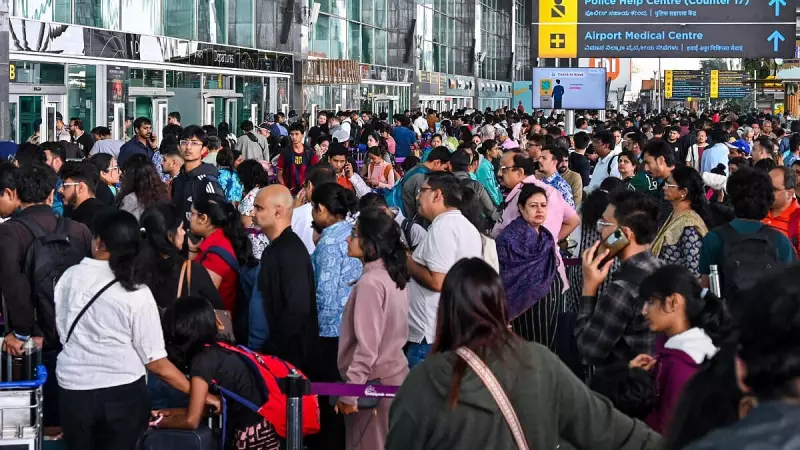
India's aviation sector faced significant turmoil on Saturday as the country's largest carrier, IndiGo, was forced to cancel a massive number of its scheduled operations. The airline grounded over 800 flights in a single day, causing widespread inconvenience to passengers across its domestic and international network.
Unprecedented Disruption Due to Crew Unavailability
The primary reason behind this large-scale disruption was an acute shortage of available cabin crew and pilots. According to sources within the airline, a confluence of factors led to the crew being marked unavailable for duty. While the airline did not specify the exact nature of these factors in its official communication, industry insiders pointed towards a combination of logistical issues, scheduling challenges, and potential leave patterns that created a perfect storm.
An IndiGo spokesperson acknowledged the situation, stating that the cancellations were a proactive measure taken to stabilize their operations. The airline emphasized that the cancellations were implemented a day in advance, on Friday, to minimize last-minute chaos at airports. They advised all affected passengers to check their flight status via the IndiGo website or mobile app before heading to the airport.

Passenger Fallout and Airline's Contingency Measures
The fallout from the cancellations was felt at major airports like Delhi, Mumbai, Bengaluru, and Hyderabad, where IndiGo commands a dominant market share. Thousands of travelers found their travel plans abruptly upended. Social media platforms were flooded with complaints from frustrated passengers seeking information on refunds, rescheduling, and alternative arrangements.
In response to the crisis, IndiGo activated its customer service protocols. The airline stated that it was making every effort to inform impacted passengers through SMS and email notifications. Standard policy dictates that passengers on cancelled flights are entitled to a full refund or can opt to be rebooked on the next available alternative. However, given the sheer volume of cancellations, re-accommodating all passengers proved to be a formidable challenge, with many reporting long wait times on customer care lines and fully booked alternative flights.
Broader Impact and the Road to Normalcy
This incident highlights the operational vulnerabilities that can arise in a fast-growing aviation market like India. IndiGo, which operates over 2,000 daily flights, is particularly sensitive to crew resource management. The scale of Saturday's cancellations is among the largest single-day disruptions for an Indian airline in recent years, not caused by external factors like weather or airspace restrictions.
The airline assured the public and regulators that it was working tirelessly to normalize its operations. IndiGo's management teams were reportedly working round-the-clock to reposition crew and aircraft to get the schedule back on track for subsequent days. The focus was on preventing a cascading effect that could disrupt the network for an extended period. Aviation analysts noted that such large-scale cancellations not only damage passenger trust but also have a significant financial impact on the airline through refunds, hotel accommodations, and lost revenue.
While the immediate crisis was centered on Saturday, the event serves as a stark reminder of the importance of robust workforce planning and buffer systems in the complex ecosystem of airline operations. Passengers are advised to stay updated with official airline channels for the latest information regarding their flights in the coming days as the situation stabilizes.






