

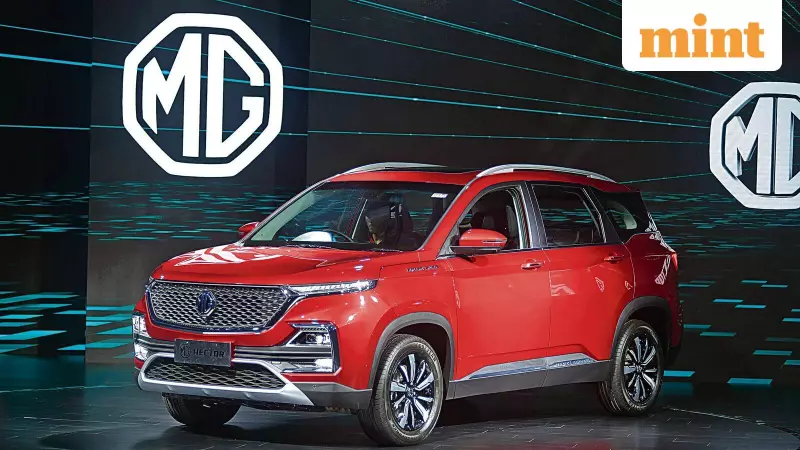
In a landmark achievement for the Indian automotive sector, JSW MG Motor India has surpassed the $1 billion revenue mark in less than six years of operations. However, this financial milestone comes with a significant caveat, as the company's losses nearly doubled in the same fiscal year, highlighting the intense challenges of scaling in the competitive market.
Financial Highs and Lows: Revenue Crosses $1B, Losses Widen
According to the latest filings with the Ministry of Corporate Affairs (MCA), reviewed by Mint, the Gurugram-based automaker recorded a revenue of ₹8,790 crore in FY25, a 10% increase from the previous year. Based on the average exchange rate for the period, this translates to approximately $1.04 billion. This makes JSW MG Motor one of the fastest carmakers to enter the elite $1-billion revenue club in India, achieving the feat in nearly half the time it took its European counterpart, Renault.
Despite the top-line growth, the company's bottom line faced severe pressure. Its losses escalated to ₹1,096 crore in FY25, a sharp rise from ₹586 crore in FY24. This indicates a return to operating losses after the company had briefly posted its first-ever operating profit in the preceding financial year, FY24.

Electric Vehicle Push Drives Sales Growth
A key driver behind the revenue surge has been the company's strategic pivot towards electric vehicles (EVs). Retail data from the government's Vahan portal shows that the company sold 57,899 units in FY25, marking a 12% growth. More importantly, the share of electric vehicles in its total sales has seen a dramatic rise—from just 11% in FY23 to an impressive 52% in FY25.
This focused EV strategy, powered by models like the Windsor, ZS, Comet, and M9, has propelled JSW MG Motor to become India's second-largest electric vehicle manufacturer, trailing only Tata Motors and surpassing established players like Mahindra & Mahindra and Hyundai Motor India. Experts note that the higher price point of EVs compared to traditional internal combustion engine vehicles has contributed to boosting its overall revenue.
"The shift to a focused EV strategy has helped the company over the past few years by giving it a distinct identity in a passenger vehicle market dominated by giants like Maruti Suzuki and Tata Motors," said Subhabrata Sengupta, partner at Avalon Consulting.
Challenges and Future Ambitions
The rapid ramp-up in EV sales, however, has also strained the company's finances. The filings suggest that increased raw material costs during the year weighed heavily on the balance sheet. In its board of directors' report, the company stated it focused on optimizing the supply chain and implementing relentless cost reduction measures to mitigate margin pressure and improve cash flows.
The financial results emerge amid significant corporate developments. The joint venture between JSW Group and China's SAIC Motor was finalized in 2024, reducing SAIC's holding to 49% and bringing in a JSW-led consortium with a 51% stake. This move was partly influenced by Indian government restrictions on Chinese investments via Press Note 3. With JSW Group's entry, the company announced plans to increase annual production capacity to 300,000 vehicles.
The conglomerate has ambitious plans for its automotive foray. JSW Group Chairperson Sajjan Jindal stated in 2024 that the aim is to capture a 33% share of India's EV market by 2030. The group is also building its own independent auto venture under JSW Motors, signaling a long-term commitment to the sector. Furthermore, the company is reportedly in talks to raise up to $300 million, which could make the JSW Group its largest shareholder.
The past year also saw a leadership change, with former Ford India MD Anurag Mehrotra taking over as managing director in February 2025, succeeding Rajeev Chaba. As JSW MG Motor India navigates the path of high growth alongside mounting losses, its journey will be a critical case study for the evolving Indian electric vehicle industry.






