

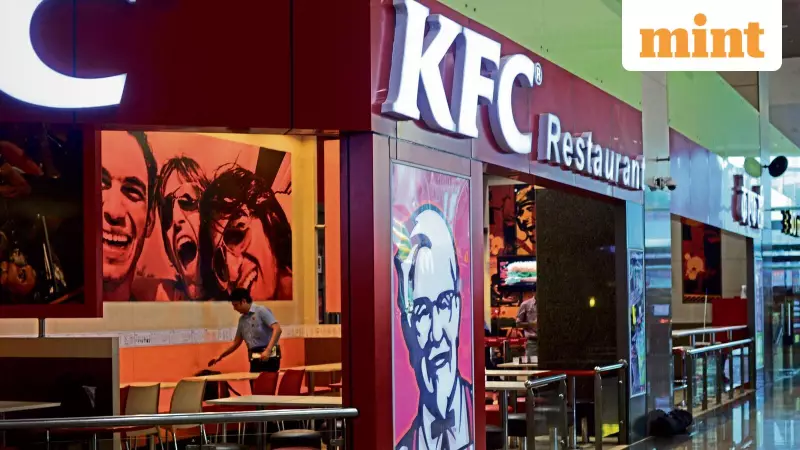
In a major consolidation move within India's competitive quick-service restaurant (QSR) sector, two of the country's largest franchise operators, Sapphire Foods India and Devyani International, announced a merger on Thursday. The all-stock deal, valued at approximately $934 million, is poised to create a formidable fast-food powerhouse in the world's most populous nation.
A Strategic Response to Market Pressures
The merger comes at a critical time for fast-food franchisees in India, who are navigating a challenging landscape marked by higher operational costs, slowing same-store sales growth, and intense margin pressure. Consumers are increasingly tightening their belts on discretionary spending, leading to fierce competition among major chains. The combined entity will directly rival the Indian operators of global giants McDonald's (Westlife Foodworld) and Domino's Pizza (Jubilant Foodworks).
As partners of Yum Brands, the parent company of KFC and Pizza Hut, Sapphire and Devyani collectively run a network of over 3,000 outlets across India and in international markets. These include dine-in restaurants for both popular brands.

Financial Mechanics and Expected Synergies
Under the terms of the agreement, Devyani International will issue 177 of its shares for every 100 shares of Sapphire Foods. The primary driver behind this consolidation is the pursuit of significant cost savings and operational efficiencies. The management projects annual synergies ranging from ₹2.1 billion to ₹2.25 billion ($23.34 million to $25.01 million), which are expected to materialize from the second full year of the merged company's operations.
Independent consumer goods consultant Akshay D'Souza highlighted the strategic necessity of the move, noting that both franchisees currently operate at a net loss, making scalability difficult. "With the single entity, if they are able to unlock even half of the expected synergies, we will be seeing a profitable enterprise... where they can control costs better," D'Souza stated.
Quarterly Performance Underscores Challenges
The recent financial results of both companies underscore the pressing need for consolidation. For the quarter ended September 30, Devyani International reported a stark reversal, posting a net loss of ₹219 million. This contrasted sharply with a modest profit of ₹170,000 in the same period a year earlier. Concurrently, Sapphire Foods saw its consolidated net loss widen to ₹127.7 million from a loss of ₹30.4 million a year ago.
The surge in costs is a clear pain point. Sapphire's consolidated total expenses climbed by 10% year-on-year to ₹7.68 billion, while Devyani's spends rose even more sharply by 14.4% to ₹14.08 billion in the September quarter. The merger is fundamentally a strategy to combat these escalating expenditures through combined scale, optimized supply chains, and shared resources.
The creation of this new QSR behemoth is set to reshape the Indian fast-food battlefield, offering a stronger combined force to compete for the value-conscious Indian consumer's wallet.






