Mahindra's Bold Bet on an Integrated Mega-Hub to Unlock Toyota-Style Economics
Mahindra & Mahindra is making a monumental strategic shift by investing ₹15,000 crore in a massive integrated manufacturing hub in Maharashtra, aiming to emulate the economic efficiencies of giants like Toyota. This move marks a departure from its legacy of fragmented plants, as the company seeks to pivot between internal combustion engine (ICE) vehicles, electric vehicles (EVs), and tractors on a single production floor to adapt to shifting market demands.
Scale Imperative: A New Manufacturing Strategy
Announced on 6 February, this 10-year commitment includes a 1,500-acre plant in Nagpur, a 150-acre supplier park in Sambhajinagar, and engine-capacity expansion near Nashik. Representing roughly 14% of Mahindra's average annual capital expenditure in its current three-year cycle, the investment underscores an ambitious recalibration to compete on scale, flexibility, and capital efficiency. With plans to launch 23 new vehicles by 2030, defend its 41.6% tractor market share, and reclaim EV leadership from Tata Motors, Mahindra faces a critical challenge.
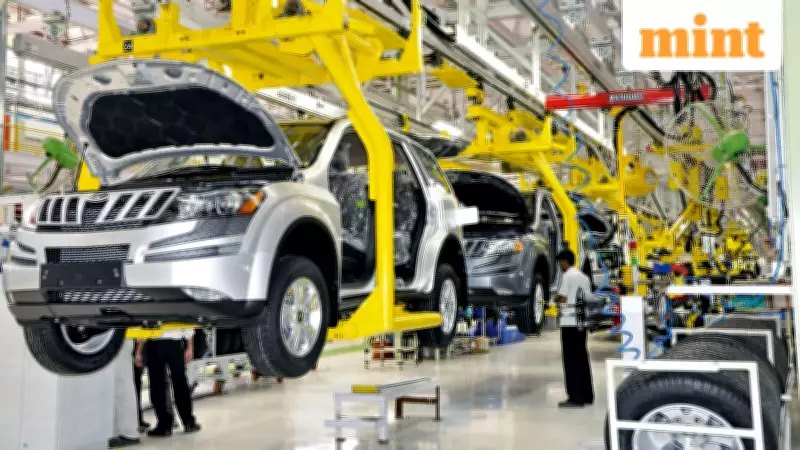
The Nagpur facility, set to start operations in 2028, aims for an annual capacity of 500,000 vehicles and 100,000 tractors. By integrating auto and farm segments under one roof, Mahindra hopes to achieve shared infrastructure, pooled logistics, and fungible capacity allocation based on market demand. This approach addresses the company's historical struggle with the cost advantages enjoyed by volume players like Maruti Suzuki and Hyundai, who amortize fixed investments across millions of units.

Architecture Advantage: Flexibility with NU_IQ Platform
Central to this strategy is Mahindra's NU_IQ architecture, a modular platform designed to accommodate ICE engines, battery-electric powertrains, and future technologies such as hydrogen fuel cells. Building multi-energy capability into greenfield infrastructure is cost-effective compared to retrofitting existing plants, a lesson learned from European automakers during their EV transitions. This flexibility hedges against India's uncertain regulatory timeline, allowing production to shift between powertrains without stranding assets.
For instance, a 500,000-unit EV line can transform into a 400,000-unit EV and 100,000-unit ICE facility within the same footprint. With ₹12,000 crore allocated to its electric subsidiary MEAL, Mahindra's multi-energy approach reduces existential risks if EV adoption curves disappoint, unlike Tata Motors' heavy bet on dedicated EV platforms.
Supplier Park Gambit: Mimicking Toyota's Model
The 150-acre Sambhajinagar supplier park represents a strategic shift toward vertical integration, mimicking Toyota's renowned supplier city strategy in Japan. By co-locating suppliers, Mahindra aims to enable just-in-time delivery for high-value, low-volume components while maintaining buffer stocks for commodity parts. This is crucial given the company's product complexity, which includes turbocharged petrol SUVs, electric crossovers, and diesel tractors, each requiring different component sets.
Regional clustering within Maharashtra could mitigate India's infrastructure bottlenecks, such as highway inefficiencies, by creating a self-contained ecosystem less vulnerable to supply chain disruptions. This initiative makes operational sense for a company launching 23 products across multiple powertrains.
Margin Question: Financial Flexibility and Long-Term Goals
Mahindra has not provided specific FY27 margin guidance, reflecting operational realities in an industry where profitability swings with commodity prices, regulatory changes, and competitive intensity. With ₹37,000 crore in operating cash generated in the previous cycle and a net surplus of nearly ₹20,000 crore, the company enters the FY25-FY27 investment cycle with a strong balance sheet, negating the need for significant external debt.

This financial flexibility allows management to prioritize long-term positioning over near-term margin commitments. The strategic focus is on establishing product leadership and platform dominance by 2028, then leveraging Nagpur's scale economics to drive margin expansion. However, the investment will increase depreciation and amortization costs over the medium to long term, though operating leverage from higher production volumes could mitigate this.
Can Mahindra Pull It Off? Execution Challenges Ahead
Mahindra's track record on mega-projects is mixed, with successes in scaling SUVs but stumbles in luxury segments and first-generation EVs. The integrated hub strategy assumes the company can achieve Toyota-like manufacturing excellence, a significant feat given its historical emphasis on ruggedness over precision. The NU_IQ platform's flexibility demands extraordinary shopfloor discipline to prevent quality issues when switching between different powertrain assemblies.
Additionally, integrating tractor and auto manufacturing poses cultural challenges, as these businesses operate on different cycles, quality standards, and customer expectations. Success hinges on execution across multiple dimensions: ramping up 23 product launches, achieving planned capacity utilization, extracting supplier park efficiencies, and maintaining quality across diverse vehicle types.
For investors, this announcement signals management confidence in India's long-term automotive growth story and Mahindra's ability to capture disproportionate market share. However, whether this confidence proves justified depends on capabilities beyond the balance sheet, such as manufacturing excellence, supplier coordination, and platform execution. The outcome will determine if Mahindra's bold bet on an integrated mega-hub pays off in the competitive automotive landscape.