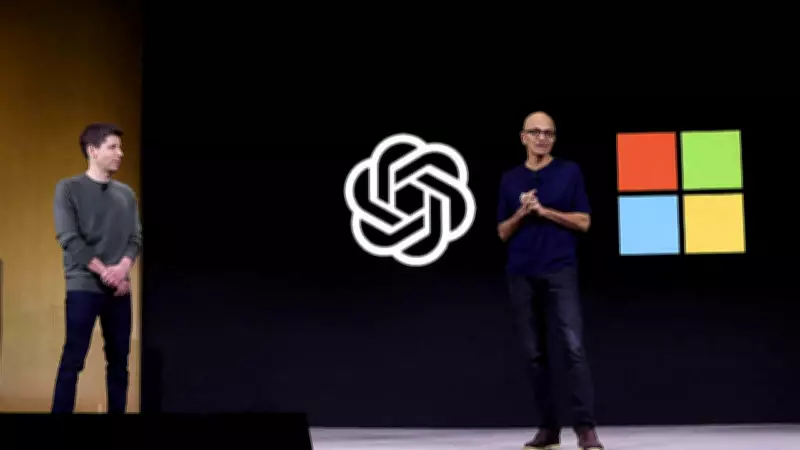
Microsoft's $360 Billion Market Value Wipeout: A Stark AI Reality Check
On January 28, the financial world witnessed a seismic event as Microsoft Corporation experienced a staggering loss of $360 billion in market value. This monumental single-day decline stands as the second-largest wipeout in the history of the United States stock market. The only instance that surpasses this catastrophic drop is Nvidia's DeepSeek meltdown from the previous year, which similarly originated from artificial intelligence delusions and speculative excess.
The OpenAI Partnership: A Costly Alliance
The primary catalyst behind this dramatic market movement is Microsoft's deep entanglement with Sam Altman's OpenAI. Following the release of earnings reports, Microsoft's stock price plummeted by a concerning 10 percent. The financial disclosures revealed a harsh reality that investors can no longer overlook: the software behemoth has effectively shackled itself to a partner that reported losses exceeding $8 billion in the previous year. OpenAI's financial burn rate is alarming, with the company spending approximately $15 million daily solely on video generation technology, while demonstrating no credible pathway toward profitability.
Perhaps the most startling revelation from Microsoft's Q1 2026 earnings call is that OpenAI now constitutes a substantial 45 percent of Microsoft's $625 billion in future cloud contracts. This means Microsoft has essentially wagered half of its cloud business on an organization whose chief executive recently declared a "code red" emergency. This declaration came as ChatGPT's user growth has stagnated and competitive pressure from Google's AI offerings intensifies.

The Circular Financing Mirage
OpenAI's entire operational model represents what many analysts describe as financial theater. The company engages in circular deals that create the illusion of growth while generating minimal tangible economic value. Here is how this mechanism functions: Microsoft has invested $13 billion in OpenAI since 2019. OpenAI then channels the majority of these funds back to Microsoft as payments for Azure cloud computing services. Both corporations record this as revenue, both present optimistic narratives to investors, yet neither has established a sustainable, profitable business foundation.
This pattern extends throughout Silicon Valley. Nvidia announced intentions to invest $100 billion in OpenAI, which would then utilize these funds to purchase Nvidia's graphics processing units. CoreWeave secured agreements worth $22 billion to supply computing power to OpenAI, subsequently receiving $350 million in OpenAI stock that could theoretically cover service costs. SoftBank spearheaded a $40 billion investment in OpenAI, then committed $100 billion to construct data centers that OpenAI would lease.
Oracle orchestrated what many consider the most absurd arrangement: a $300 billion commitment to build data centers for OpenAI, which OpenAI would then pay roughly $300 billion to utilize over multiple years. This represents the same capital circulating in a closed loop. Oracle's stock has consequently crashed 45 percent from its September peak, erasing over $360 billion in value as investors recognized they had purchased into a sophisticated Ponzi scheme with superior branding.
Altman's Trillion-Dollar Gamble and Microsoft's Dilemma
Sam Altman has committed OpenAI to an astonishing $1.4 trillion expenditure on AI infrastructure by 2033. This figure exceeds Amazon's total market valuation and doubles the annual budget of the United States military. This ambitious plan rests on the speculative assumption that ChatGPT will evolve into a revolutionary, revenue-generating technology faster than OpenAI can consume capital.
Microsoft now finds itself trapped financing Altman's vision. The company's capital expenditures surged to $37.5 billion last quarter, marking a 66 percent year-over-year increase. This exceeded analyst expectations by $1 billion and surpassed the previous quarter by $3 billion. Approximately two-thirds of this spending is directed toward GPUs and rapidly depreciating AI infrastructure.

Meanwhile, Azure cloud growth decelerated to 39 percent, down from 40 percent in the prior quarter and below Wall Street's 39.4 percent forecast. Microsoft's Chief Financial Officer Amy Hood acknowledged that the company is intentionally limiting Azure capacity for paying customers to redirect computing resources toward internal AI products like Copilot and GitHub Copilot. Essentially, Microsoft is forfeiting revenue from Fortune 500 companies to provide free computing power to AI products that demonstrate limited user adoption.
Microsoft 365 Copilot reports 15 million paid seats, which appears significant until contextualized against Microsoft's 450 million total M365 commercial seats, representing a mere 3 percent adoption rate. UBS analysts have publicly questioned Copilot's investment worthiness, noting that M365 revenue growth shows no acceleration attributable to Copilot, and usage data does not indicate substantial ramp-up.
Competitive Erosion and Financial Projections
OpenAI's competitive standing is deteriorating rapidly. Google's Gemini models now match or surpass ChatGPT's capabilities while operating on more efficient infrastructure. ChatGPT's user growth has plateaued in European markets. China's DeepSeek developed a competitive model at a fraction of the cost, highlighting the AI industry's extravagant spending patterns.
Deutsche Bank analyst Jim Reid estimates OpenAI will accumulate losses of $140 billion between 2024 and 2029, stating, "No start-up in history has operated with expected losses on anything approaching this scale. We are firmly in uncharted territory." Financial expert Sebastian Mallaby predicts OpenAI could deplete its funds within 18 months. One venture capital investor described the situation to The Economist as "the WeWork story on steroids."
The Inescapable Contract and Strategic Paralysis
The most troubling aspect for Microsoft is the apparent lack of an exit strategy. The company's contract with OpenAI includes a clause prohibiting Microsoft from developing its own artificial general intelligence until 2030. Should OpenAI collapse, Microsoft would be legally barred from constructing a replacement for three and a half years. Those $625 billion in cloud commitments would not disappear, leaving Microsoft with massive, purpose-built data centers lacking their intended customer, financed by debt requiring repayment.
Oracle is already experiencing this nightmare, having raised tens of billions through bonds to build OpenAI infrastructure while its credit risk reaches levels unseen since 2009. Microsoft has spent three years publicly aligning itself as OpenAI's indispensable partner, with CEO Satya Nadella frequently appearing alongside Sam Altman. Abandoning OpenAI now would force Microsoft to admit to shareholders that it wasted $13 billion and numerous strategic opportunities pursuing an illusion, resulting in severe reputational and financial damage.
Market Reckoning and Broader Implications
The January 28 market crash was not irrational panic but rather the financial markets performing essential arithmetic. Investors evaluated Microsoft's $37.5 billion quarterly AI infrastructure spending, OpenAI's $12 billion quarterly losses without revenue growth, circular financing arrangements that shuffle money without creating value, and slowing Azure growth alongside exploding capital expenditures. Their response was decisive selling.
Business professor Erik Gordon warned that when the AI bubble bursts, "the suffering will be more painful than the aftermath of the dot-com bubble." The dot-com bubble involved companies with relatively modest market capitalizations built on hype. Microsoft is a $3.2 trillion corporation that lost 10 percent of its value in one day because it tethered itself to Sam Altman's sinking venture.
The contagion is already spreading. Software stocks crashed across the board on January 28. ServiceNow fell 9.9 percent, Salesforce dropped 6.1 percent, and Atlassian declined at least 6 percent. The market is systematically repricing every company exposed to AI speculation. Microsoft spent decades cultivating credibility as a stable, profitable enterprise delivering consistent shareholder returns. Sam Altman has jeopardized that reputation in under three years through circular deals, illusory revenue, and a $1.4 trillion spending plan predicated on AI magically becoming profitable before reality intervenes. January 28 represented Microsoft's bill coming due, with Sam Altman conspicuously absent to assist in payment.