Mumbai's real estate market has evolved in distinct waves, from South Mumbai's dominance to suburban expansion, followed by the rise of Navi Mumbai and Thane. Now, with the Maharashtra government's Mumbai 3.0 project, the next chapter unfolds across the extended Mumbai Metropolitan Region (MMR). Though not yet formally defined, developers and experts use the term to describe Mumbai's outward expansion beyond traditional urban boundaries, driven by saturated core areas, rising property prices, and limited land availability.
Infrastructure Driving Growth
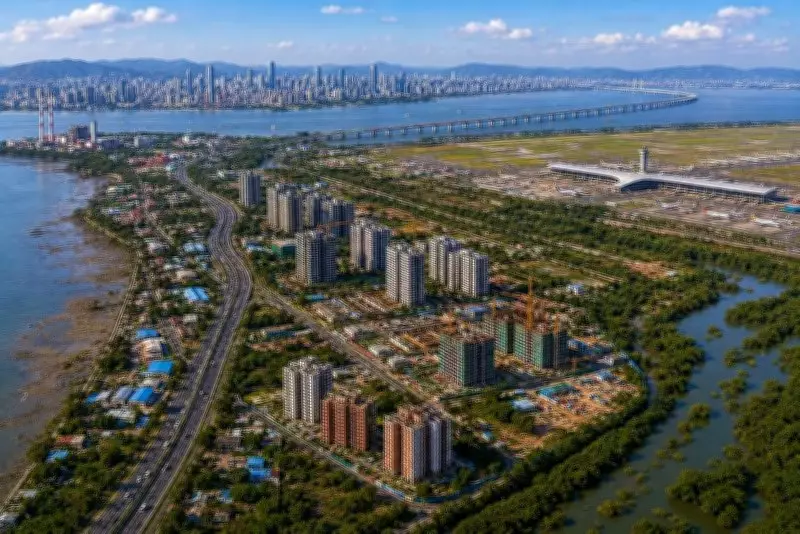
As affordable housing challenges intensify, homebuyers and investors shift focus to emerging corridors like Panvel, Karjat, Khalapur, Pen, and Alibaug. These areas benefit from infrastructure investments such as the Navi Mumbai International Airport, Atal Setu, metro expansion, and multimodal transport networks. Bhavesh Shah, Joint Managing Director of Today Group, notes that this phase creates multiple simultaneous growth corridors, with infrastructure actively determining where growth happens.
Affordability and Buyer Preferences
Vishal Ratanghayra, Founder & CEO of Platinum Corp., highlights that affordability remains a key demand driver, especially among younger homebuyers gravitating towards plotted developments and organized land communities. These buyers prioritize long-term asset appreciation and future-ready communities over standalone built-up assets. Organized plotted communities, integrated townships, and branded land developments are shaping a decentralized growth model across MMR.

Rising property prices in core Mumbai and parts of Navi Mumbai push investors and end-users to explore micro-markets with long-term value. Mega projects like the Mumbai Trans Harbour Link (MTHL), Virar–Alibaug Corridor, and Panvel–Karjat railway expansion alter travel patterns and perceived distances, reshaping residential and investment demand.
Changing Buyer Mindset
Porush Jhunjhunwala, CEO of Banke International Properties, observes that buyers are more comfortable traveling longer distances if connectivity is efficient. This opens new growth corridors. Plotted developments gain traction over apartments, especially among younger investors, NRIs, and second-home buyers. Bhavesh Shah adds that buyers today are strategic, focusing on quality of life and long-term wealth creation. Unlike mature markets, emerging corridors offer scale, planned development, and strong upside.
Plotted developments provide flexibility—buyers can purchase land and build later, appealing in an environment of rising construction costs and demand for low-density living. Developers integrate landscaped greens, wellness spaces, clubhouses, and co-working infrastructure into projects, creating future-ready ecosystems.
Regulatory Transparency and Appreciation
Growing interest in plotted developments is supported by regulatory transparency and digitization, with developers emphasizing clear land titles and compliance. Land investments often see sharper value appreciation once infrastructure projects become operational. NRIs view land as a stable long-term asset, while younger buyers approach it as future-oriented investments with significant upside over five to ten years.
Parthh K Mehta, CMD of Paradigm Realty, notes that Mumbai 3.0 impacts all asset classes, with luxury buyers investing in plotted developments. Transformative projects like the 21.8-km Atal Setu and new expressways improve connectivity. In micro-markets like Panvel, Karjat, and Khalapur, plotted developments attract end-users and investors. Prices range from ₹3,000 to ₹15,000 per sq. ft, significantly lower than Mumbai's luxury markets (₹50,000–₹1 lakh per sq. ft). Well-connected nodes could see annual appreciation of 15-25% over the next few years.

Future Outlook
Porush Jhunjhunwala believes Mumbai 3.0 will evolve as a network of interconnected micro-markets, functioning as extensions of Mumbai's economic ecosystem. Success will depend on connectivity predictability rather than physical distance. As infrastructure matures, emerging corridors will become urban clusters with residential, commercial, and social ecosystems. Mumbai's next phase may no longer revolve solely around vertical growth in the core. Plotted developments are emerging as the defining expression of outward expansion, where infrastructure, affordability, and aspirational living converge across MMR.