

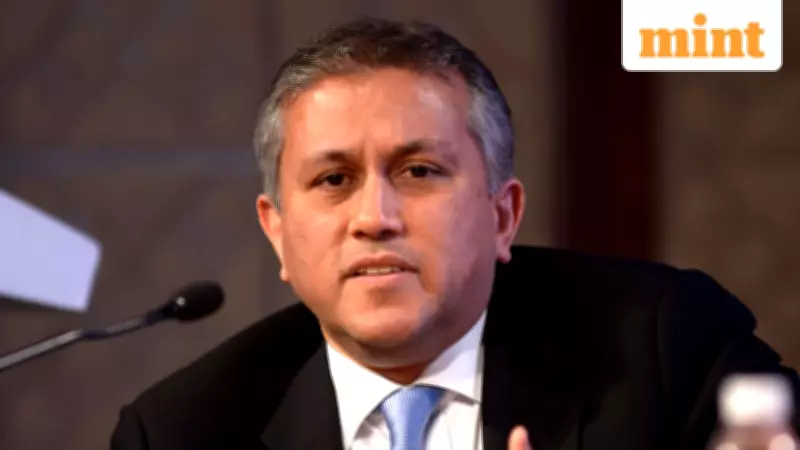
Former Citibank India CEO Pramit Jhaveri Exits Tata Trust Amid Governance Discord
In a significant development within India's corporate philanthropy landscape, Pramit Jhaveri, the former Chief Executive Officer of Citibank India, has decided not to seek another term as a trustee of the Sir Dorabji Tata Trust (SDTT). His current tenure concludes on 11 February 2026, marking the end of his six-year association with this pivotal philanthropic entity that holds a substantial stake in the Tata Group.
A Decision Rooted in Evolving Dynamics
Jhaveri formally communicated his decision in a letter addressed to Noel Tata, the current chairman of the Tata Trusts, on Saturday. In his correspondence, he stated, "I have served as a Trustee of the Sir Dorab Tata Trust (SDTT) since February 12, 2020, when Mr Ratan N. Tata invited me to join as a Trustee. As discussed with you some days ago, I am now writing to let you know that I do not wish to be considered for re-appointment as a Trustee of SDTT when my current term expires on February 11, 2026."
This move positions Jhaveri as the second trustee to depart from the Tata philanthropic entities within the last three months, underscoring a period of notable transition and internal discord. The tensions have become increasingly apparent since Noel Tata assumed leadership of the two principal trusts in October 2024, following the passing of Ratan Tata.

Broader Context of Trustee Reshuffling and Control
Jhaveri's departure occurs against a backdrop where Chairman Noel Tata is actively seeking to consolidate his influence over the trusts. A key aspect of this effort involves the proposed induction of his son, Neville Tata, as a principal trustee, a move that requires unanimous approval from all existing trustees. This has become a focal point of contention, reflecting deeper issues of control and transparency within the governance structure.
The recent months have witnessed several high-profile changes:
- In October 2025, Mehli Mistry, a close confidant of the late Ratan Tata, was forced to step down after opposition from Noel Tata, Venu Srinivasan, and Vijay Singh.
- Subsequently, in November, Neville Tata and former Titan CEO Bhaskar Bhat were inducted into the SDTT board.
- Earlier, in September 2025, Jhaveri, along with Mistry and Darius Khambata, opposed Vijay Singh's continued representation on the Tata Sons board, leading to his removal as a Tata Trusts nominee.
Ownership Structure and Governance Challenges
The Sir Dorabji Tata Trust and the Sir Ratan Tata Trust (SRTT) collectively own more than 51% of Tata Sons, the holding company of the diversified $300-billion Tata Group. Specifically:
- SDTT holds 27.98% of Tata Sons.
- SRTT holds 23.56% of Tata Sons.
- Other smaller trusts contribute an additional 14.4%, giving the philanthropic entities a majority ownership of 65.9% in Tata Sons.
The remaining stakes are distributed among the Shapoorji Pallonji Group (18.38%), nine Tata Group companies (12.86%), and seven individuals (2.87%). This substantial ownership underscores the critical role these trusts play in the group's strategic decisions.
Implications for Tata Sons and Future Governance
The ongoing discord within the Tata Trusts arrives at a crucial juncture for Tata Sons. The company is currently engaged in discussions with the Reserve Bank of India (RBI) regarding its status as an upper-layer non-banking financial company (NBFC), which mandates listing on stock exchanges by September 2025. Additionally, Tata Sons must navigate providing an exit to its largest minority shareholder, the Shapoorji Pallonji Group.

With Tata Sons operating with a board of six members, any expansion requires approval from the Tata Trusts. The current lack of consensus among trustees, as highlighted by Jhaveri's decision, could potentially complicate these significant corporate maneuvers. An executive privy to the developments noted that the "latest development reflects the lack of consensus among Trustees, leading Jhaveri not to seek a renewal on the board."
The situation remains fluid, with the philanthropic entities at the heart of one of India's most storied industrial groups facing a period of introspection and realignment. The outcome of these governance challenges will likely have far-reaching implications for the future direction of the Tata Group.





