

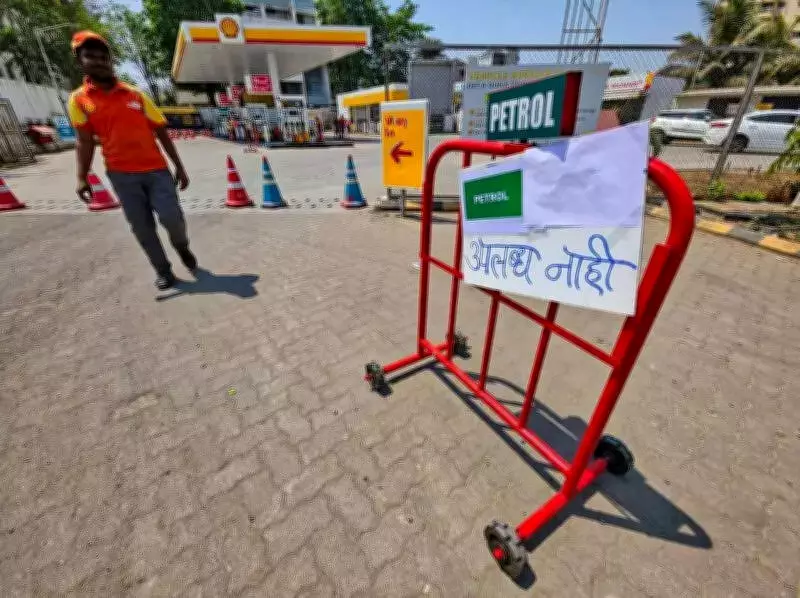
Pune Fuel Crisis: Panic Buying and Payment Shift Cause Petrol Pump Shortages
In Pune, numerous petrol pumps reported running out of petrol and diesel on Thursday, creating a temporary fuel crisis in the city. Dealers have clarified that there is no actual shortage of fuel supply from oil companies. Instead, they attribute the situation to two primary factors: widespread panic-buying triggered by reports of shortages in other cities and a recent shift to an advance payment system implemented by oil marketing companies.
Surge in Sales Due to Panic Buying
Petrol pump dealers in Pune have observed a sharp increase in sales over the past two days, with estimates indicating a surge of nearly 70% since Wednesday. This spike is directly linked to panic-buying among motorists, who became worried after hearing news about fuel shortages in various parts of Maharashtra. One dealer explained, "Panic buying is the main cause. Sales have shot up by almost 70% since Wednesday. There is actually no shortage, but in other cities, the same phenomenon has led to long queues and pumps running out of petrol and diesel. News channels are reporting this, and after seeing that, people in Pune have also started panic buying."
This behavior mirrors recent incidents, such as the LPG shortage reported in parts of Maharashtra, where sudden bulk purchases disrupted the normal supply cycle. Dealers noted that the panic buying has overwhelmed the capacity of petrol pump tanks, which are designed for normal consumption levels. For instance, a dealer whose outlets in Mundhwa and Keshavnagar ran out of fuel stated, "On Wednesday, we had enough stock for Thursday, but because of panic buying our sales almost doubled, so even Thursday's stock got over. Petrol pump tanks have limited capacity, and when sales suddenly increase, the stock finishes fast."

Impact of Advance Payment System
Compounding the issue is a recent change in payment policies by oil companies. Until March 16, fuel was supplied on credit, allowing dealers to pay after receiving the product. However, companies have now shifted to an advance payment system, requiring dealers to pay upfront before placing orders. This shift has created financial challenges for many petrol pump owners. A dealer elaborated, "Till March 16, companies were giving fuel on credit. For example, if you took product today, you could pay tomorrow or the day after. Now, what all the companies have done is that you have to pay first and then place your order. Basically, they have shifted to an advance payment system, which is also creating an issue for pumps, deterring them from buying more fuel."
Dealers were not given prior intimation about this change, leaving them unprepared to arrange large funds quickly. Many rely on credit in the market to purchase petrol, making it difficult to mobilize substantial amounts overnight. As a result, some pumps, particularly in outskirts areas, have faced delays in ordering fuel. Another pump owner who ran out of fuel on Thursday evening said, "Earlier, the companies used to give fuel on credit, but the system has stopped and we have to make advance payment. For one load, around Rs20 lakh gets blocked, so arranging money suddenly becomes difficult. Because of that, we could not place the order in time and get fuel."
Logistical Challenges and Supply Assurance
The sudden increase in demand has also led to logistical bottlenecks. Tankers ferrying petrol are typically shared among multiple pumps and are scheduled based on normal consumption patterns. With sales surging, the need for additional tanker trips has arisen, causing delays. A dealer explained, "For example, if I expect my pump to sell 10,000 litres in a day and suddenly 17,000 litres gets sold, the tanker will take time to arrive. Companies and transport tankers are also prepared for normal consumption. If my pump usually needs one tanker a day and suddenly I need two, then the second tanker also has to be arranged, which takes time."

Despite these challenges, oil marketing company officials have assured that there is no shortage of fuel supply. An OMC official stated, "As far as supply is concerned, it is going as usual. In fact, supply is higher than normal. On a normal day around 130 tankers are filled, but now around 190–200 tankers are being loaded. There is no shortage of stock. Everything is running normally. We have enough supply points, stock is available, and there is no shortage from the company side." Dealers echoed this, noting that if payments are made and orders placed, fuel is delivered without rationing.
Broader Context and Consumer Behavior
The situation in Pune highlights how panic buying can exacerbate local shortages even when overall supply remains stable. Consumers who typically fill small amounts are now opting for full tanks, further straining resources. A petrol dealer remarked, "The problem is that people who usually fill for Rs100–200 are now filling full tanks." This shift in behavior, combined with the new payment system, has created a perfect storm for temporary fuel unavailability.
In summary, the fuel shortages at Pune petrol pumps are not due to a lack of supply but are driven by panic buying and the financial constraints imposed by the advance payment system. Dealers urge calm among consumers to allow the supply chain to normalize, emphasizing that with timely payments and reduced panic, the situation can quickly stabilize.





