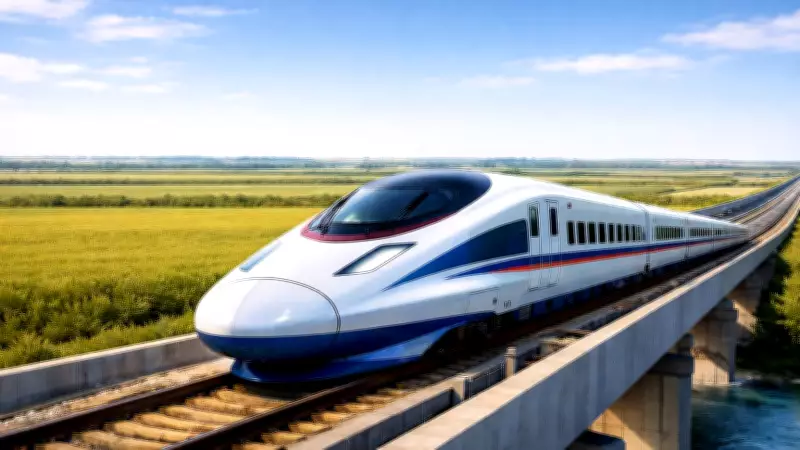
Railway Board Directs NHSRCL to Prepare DPRs for Seven New High-Speed Rail Corridors
In a significant push to accelerate India's high-speed railway program, the Railway Board has issued a directive to the National High Speed Rail Corporation Limited (NHSRCL). The corporation has been tasked with preparing detailed project reports (DPRs) for seven newly proposed high-speed rail corridors, as announced in the Union Budget 2026-27. This move is part of a broader strategy to enhance connectivity and modernize the nation's rail infrastructure.
Expansion of High-Speed Rail Network
India is currently developing its inaugural high-speed rail corridor, the Bullet train project, which connects Mumbai and Ahmedabad. Building on this foundation, the Railway Board's latest directive aims to expand the network significantly. During a high-level meeting, officials emphasized the need for immediate steps to initiate the implementation of these new projects. It was also decided that existing DPRs for corridors where studies have been completed would be updated with current cost estimates to assess financial viability accurately.
The seven new high-speed rail corridors announced by Finance Minister Nirmala Sitharaman in her Budget speech are:

- Mumbai-Pune
- Pune-Hyderabad
- Hyderabad-Bengaluru
- Hyderabad-Chennai
- Chennai-Bengaluru
- Delhi-Varanasi
- Varanasi-Siliguri
These corridors, spanning approximately 4,000 kilometers, are projected to cost around Rs 16 lakh crore, as stated by Railways Minister Ashwini Vaishnaw. While not identical to earlier proposals, they are interlinked, forming a cohesive network across key economic regions.
NHSRCL's Role and Previous Submissions
NHSRCL, a special purpose vehicle incorporated in 2016, is responsible for financing, constructing, maintaining, and managing India's high-speed rail corridors. Prior to this new directive, NHSRCL had submitted DPRs for seven other corridors, including Delhi-Varanasi, Delhi-Ahmedabad, Mumbai-Nagpur, Mumbai-Hyderabad, Chennai-Mysore, Delhi-Amritsar, and Varanasi-Howrah. These reports are currently under examination, highlighting the ongoing efforts to assess and plan for a comprehensive high-speed rail system.
Focus on Quality and Workforce Development
The Railway Board has also emphasized the importance of maintaining high standards across all high-speed rail systems in India. To ensure this, it has directed the establishment of a dedicated field-based core team for each project. This team will oversee pre-construction activities and the preparation of contract documentation, among other critical tasks.
A senior railway official highlighted, "In the meeting, it was stressed that there must be a robust manpower of trained technical personnel for the high-speed rail projects. Progress on identified action points will be reviewed at the highest level, which is essential for the next phase of the Bullet train project." This focus on workforce training and quality control is crucial for the successful execution of these ambitious infrastructure endeavors.
Progress on the Mumbai-Ahmedabad Corridor
Meanwhile, the first Bullet train project between Mumbai and Ahmedabad is advancing steadily. The initial stretch from Surat to Billimora is scheduled to become operational by August 15, 2027. Subsequent sections, including Vapi-Surat, Vapi-Ahmedabad, and Thane-Ahmedabad, will follow, with the entire corridor expected to be fully operational by 2029. Notably, the cost of this project has nearly doubled from an estimated Rs 1.08 lakh crore to Rs 1.98 lakh crore, reflecting the complexities and scale of high-speed rail development.
This expansion of India's high-speed rail network marks a transformative step in the country's transportation landscape, promising enhanced connectivity, economic growth, and technological advancement.